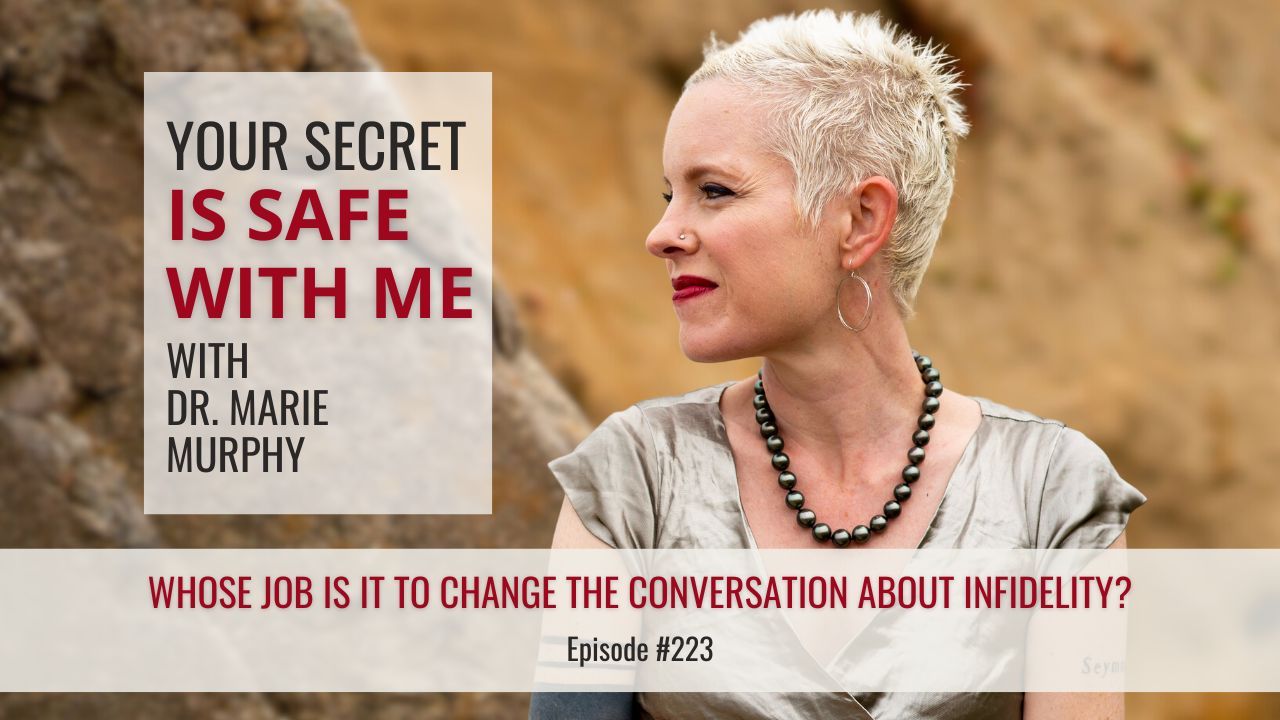
223: Whose Job Is It to Change the Conversation About Infidelity?
Dec 17, 2025Have you ever found yourself keeping silent when someone makes a sweeping judgment about infidelity?
Maybe you've sat through conversations where people say things like "all cheaters are damaged people" or "once a cheater, always a cheater," and you've felt your stomach twist into knots.
You wanted to speak up, but you didn't. You couldn't. The fear of being found out or judged kept you silent. I get it. The stigma around infidelity can feel overwhelming and isolating.
But here's the thing: if you want to see the dominant conversation about infidelity become more nuanced and less stigmatized, you might need to participate in changing it yourself.
Join me this week as I explore why changing the dominant narrative about infidelity isn't someone else's job - it's yours, mine, and everybody else’s. You'll discover why your voice matters in changing these conversations, how to respond to judgmental comments without defending infidelity, and why speaking up about your experiences might educate people in ways you never expected.
Are you ready to resolve your infidelity situation in a way that’s truly right for you? If so, let’s get to work. There are two ways you can have me as your coach:
- You can enroll in You’re Not the Only One, my self-guided, online course that gives you the teachings and tools you need to resolve your infidelity situation in a way that you feel great about.
- If you want my personalized attention and support, we can work together one-on-one via Zoom.
Why wait any longer to find relief and a clear path forward? The rest of your life – beyond the drama and difficulties of your infidelity situation – is waiting for you!!
What You’ll Learn from this Episode:
-
Why people engaging in infidelity haven't been able to collectively challenge stigma the way other marginalized groups have.
-
How to respond to ridiculous statements about infidelity without having to defend it.
-
Questions you can ask that invite others to examine their blanket judgments.
-
The power of arguing for recognizing complexity in human experience rather than defending specific behaviors.
-
How being the first person to speak up can create ripple effects you may never see.
Listen to the Full Episode:
Episodes Related to Changing the Conversation About Infidelity:
Featured on the Show:
-
Check out my brand-new YouTube channel!
-
If you want to submit a question for me to try and answer on the podcast, click here or email [email protected].
- If you have benefitted from this podcast, I would greatly appreciate it if you would rate and review the podcast, or send me a blurb about how it has been helpful to you. Click here to rate and review, or send your comments to [email protected]. Don’t forget to add your initials – real or fake!
Are you ready to resolve your infidelity situation in a way that you feel great about? There are two ways we can work together:
- You can purchase the DIY version of my program, You’re Not the Only One
- We can work together one-on-one
Resolving your infidelity situation may take some effort. And it is also totally do-able. Why stay stuck for any longer? Let’s find you some relief and a clear path forward, starting today.

Hi everyone, I’m Dr. Marie Murphy, and I’m a non-judgmental infidelity coach. If you are engaging in anything you think counts as infidelity, I can help you deal with your feelings, clarify what you want, and make decisions about what you’re going to do. No shame, no blame, no judgments. My job is to help you navigate your infidelity situation in a way that you feel great about so that you are able to experience love and sex and relationships and intimacy and connection in the ways that you truly want to – AND have enough bandwidth left over for all of the other important stuff in your life, too. Infidelity situations can be VERY exciting and life-affirming and all-consuming, and that can be a pretty cool experience to have – at least for a while. But infidelity situations can also be AGONIZING in a lot of ways. And while I would be the first person to say that sometimes agony is kind of exquisite, sometimes it really isn’t. So when you’re ready to start dealing with your infidelity situation in a way that’s truly right for you, let me help you do it. There are two ways you can have me as your coach. We can work together one-on-one via Zoom, or you can enroll in my online course, You’re Not the Only One. To get started with either option, go to my website, mariemurphyphd.com.
I went to see the fantastic W. Kamau Bell a few months ago at the Punchline in San Francisco and although I enjoyed much of what he said very much, one particular thing he said really stuck with me. “Whose job is it to resist fascism?” he asked the audience. And he supplied his own answer which was “Your job. My job. And everybody else’s job.”
Such a simple – and to me, obvious – thing to say, but it struck me all the same. Sometimes we forget that there might not be anybody coming to save us. Sometimes we forget that there might not be anyone else who’s going to volunteer to do the hard thing that really needs to be done. Sometimes we forget that if we want to see change in the world, we have to be the change we wish to see in the world. That line is attributed to Mahatma Ghandi, but others have espoused versions of the same thing. Over and over again, our wisest teachers tell us that it is our job to co-create the world we want to inhabit.
And this is relevant to infidelity in potentially a lot of ways, but the specific one I’m concerned with today is this. I quite often work with clients who are currently engaging in infidelity and are TERRIFIED of people they know finding out that they are, or have been, engaging in infidelity. They’re terrified of what people will think about them, they’re terrified of what people will say about them, and they’re afraid the whole world will shun them. And sometimes people say things to me like, “Well, if people say bad things about infidelity, or bad things about me engaging in infidelity, I don’t know what I’ll do!” Or they just say that if those things were to happen, it would be really, really terrible. They don’t want people to say the horrible things they might say. They don’t want people to think the horrible things about cheaters that they might think. They just don’t want to have to deal with any of that stuff.
But alas, that stuff is out there. Mainstream understandings of infidelity are what they are. The current, dominant conversation about infidelity is what it is.
Now, I have talked a fair amount about dealing with other people’s opinions in other episodes. And if you’re worrying about what other people might say or think about you, go look up those episodes and listen to them. But today I’m going to offer a different angle on dealing with the things that other people might say and do say about infidelity.
Today I’m going to suggest that not only is it your job to learn how to deal with other people’s opinions, it just might also be your job to participate in the process of changing the conversation about infidelity.
Which might be the last thing you feel like doing. But if not you, then who? If you aren’t going to speak up and change the conversation around infidelity, who is?
Well, I am. And some other people are, or have, too. But if we want to see big changes in the dominant conversations about infidelity, we need a lot more people to speak up and say their piece if the collective conversation about infidelity is going to change in all the ways it needs to. And I want you to consider that that includes you.
When I suggest this to people, they sometimes get very defensive and they say, “Well how I am supposed to contend with the enormity of the ill-will towards cheaters all by myself? I can’t possibly do it all alone.”
And that’s right. You can’t do it all alone. We need a critical mass of voices. But you can still do your part. You participation helps build the critical mass. And I encourage you to believe in the value of your own participation.
As you may or may not know, I’m a sociologist by training, and as a sociologist, one of my areas of interest was stigma, and how stigma is socially created, and how stigma is collectively challenged, or resisted.
And when it comes to stigma, people who are engaging in infidelity occupy a funny place in the social world. They’re engaging in a behavior that is stigmatized, but they don’t engage in this behavior collectively, it’s hard for people who are engaging in infidelity to recognize each other as members of a group, or even as people who are having similar experiences. Some people who are secretly engaging in behavior that is stigmatized do it with other people who are doing the same thing, OR they find ways of congregating with, or connecting with other people who are doing the same thing. And so the folks who are engaging in the behavior that’s considered stigmatized can recognize that they aren’t the only one who does the thing, and potentially draw strength and support from being members of a group that has something in common. And, when people come together collectively, they can collectively challenge the stigma society has bestowed upon them.
So for instance, in the United States, trans and queer folks had the Compton’s Cafeteria riot in San Francisco, which is the lesser-known precursor to the more famous Stonewall rebellion, and these collective uprisings are widely seen as the beginning of organized resistance to police harassment of trans, gay, and queer people in the United States. They are recognized as moments in history in which what we now sometimes think of as LGBTQI+ activism began. These riots changed history! And they were made possible in part because people who were doing similar stigmatized things or who embodied similarly stigmatized categories of personhood were able to recognize each other, form communities, and engage in collective action.
To the best of my knowledge, there have not been any comparable moments in history when people engaging in infidelity have come together and collectively resisted the stigma foisted upon them. People engaging in infidelity are not a social group, and they have not engaged in collective action. They have not come together to create a moment analogous to queer people standing up, literally and figuratively, to say, “we’re here, we’re queer, get used to it.”
Many scholars argue that the reason why queer rights are what they are today is because of queer social movements. Although I am NOT suggesting that everything’s fine for non-heterosexual folks and people who reject the gender binary, things HAVE changed a lot in my lifetime. I’m speaking primarily about the United States, but this is true elsewhere in the world, too. If you fall anywhere within or near the LGBTQI+ realm of personhood, life today looks a lot different than it did 50 years ago.
And that is NOT because a bunch of straight people woke up one morning and realized, “Gee, it’s not such a big deal to be gay. Queerness isn’t threatening to me. People can live out gender in whatever ways they want to! I’m totally fine with those homosexuals doing their thing!” That is NOT what happened. It took a lot of people who were socially marginalized doing brave things, over and over again, even when it was scary and hard and sometimes life threatening for them to do it.
And it’s not just queer people who have done this for themselves. So many groups of humans have had to stand up and demand their rights and their dignity. Maybe you have. Maybe your forbears had to. Maybe you owe your very existence to people who were courageous enough to stand up and say to the world, I have a right to exist, just as I am. Me and my people, we have a right to exist, just as we are.
But then again, maybe you’ve never had to do that before. Maybe you’ve never been part of a marginalized or oppressed social group. Maybe your ancestors didn’t have to struggle to be accepted as fully human humans. Maybe that hasn’t been part of your experience.
And furthermore, maybe you’ve never done anything, as an individual, that’s been considered even mildly unconventional by the standards of your community. Maybe you have lived your life thus far without making too many waves. Maybe you never wanted to make any waves. Moreover, maybe you’ve gotten nothing but approval for your entire life! Maybe you’re used to getting a gold star for everything you do – even if that’s just existing.
And thus, you may not be the least bit thrilled to find yourself in the position of being a person who is doing a stigmatized thing that some people have very nasty things to say about. You may never have imagined that you would be a person who is doing a thing that other people consider bad. You may never have wanted to find yourself in the position of having to speak up on behalf of yourself or on behalf of anyone engaging in infidelity. You may never have wanted to find yourself in the position of acknowledging behavior that you yourself consider morally dubious – even if you also see the humanity in your own behavior.
Here's something for you to consider: if somebody says something ridiculous about infidelity, or if somebody says something ridiculous about you engaging in infidelity to you, you get to choose what you say in response. You don’t have to meet their blanket judgments of infidelity with blanket defenses of infidelity. Other people may see this as a matter of infidelity simply being bad, end of story, but you don’t have to respond as if that assessment has any merit!
So for example, if somebody says something like, “Oh, well all cheaters are damaged people who don’t care about other people’s feelings,” you could ask a question like, “How can you know that?” You aren’t arguing with them. You aren’t defending anything. You’re offering a question that implies that there might be room for them to question their position. And maybe they’ll do just that.
Also, if you find yourself in the position of thinking that you do have to defend infidelity, or people who engage in it, but defending infidelity doesn’t seem quite right to you, there are many other positions you could take. You might argue for the need to recognize the complexity of the human experience, perhaps especially when it comes to love and intimate relationships. You might argue for the value of refraining from judging other people’s lives. You could make a case for respecting people’s privacy. You could argue that there are so many better things to focus on and talk about than other people’s so-called failings. There are lots of things you can say and do to contribute to changing the conversation around infidelity.
And doing your part to change the conversation around infidelity certainly does not mean that you have to expose all of your private business to the world in general, or to any person or group of people in particular. You have the right to share as many or as few details of your own experience as you want to.
But – to paraphrase the Rabi Tarfon – even if it is not your part to finish the task, neither are you free to desist from it. We’re all in this together, people. If you want the conversation around infidelity to be different, if you want the dominant discourses around infidelity to be different, if you want infidelity to be less stigmatized, if you want the general public’s understandings of infidelity to be more nuanced, you have to contribute to making these changes.
Now, I just said you “have to” contribute to making these changes, but that isn’t really true. You don’t HAVE to. You don’t have to do anything! It is your prerogative to decline to take action, period. If people make general comments about infidelity that you consider abhorrent, you don’t HAVE to respond. If somebody says something hideous to you about your infidelity, you don’t have to respond.
But if you choose not to respond, I encourage you to think about why you’re making that choice. Sometimes there might be good reasons not to speak up. For instance, if you are at a moment in your life when you are so depleted that you cannot spare an ounce of energy on anything that isn’t essential, well, you might find it reasonable to conserve your energy for what is truly essential.
But even if there might be some good reasons to refrain from speaking up – sometimes – I also want you to consider that if everyone kept their mouth shut because speaking up was too uncomfortable, we’d all be totally fucked. If no one ever spoke up to argue for the humanity of stigmatized behavior or stigmatized people, we’d be living in a very different world.
The way we collectively tend to think about infidelity contributes to a lot of human suffering.
And we all have the power and the responsibility to contribute to our collective well-being, in the ways that we are uniquely positioned to do so. And even if you never would have chosen this, you may happen to be uniquely positioned to speak up about infidelity in ways that change the conversation around infidelity.
I consider this to be a sad fact of the human experience, but credible sources repeatedly find again that people tend to change their minds about things when they personally know someone who has done that thing or is that thing or has been affected by that thing. Like, people start to care about school shootings when they know someone who was killed in one. People start to realize that hey, maybe transgender people aren’t so bad when they realize that someone they know is trans, or they see someone go through a gender transition. People begin to get really concerned about climate change when their parents’ home goes up in flames, or is washed away by a flood, or a hurricane, or swept up by a tornado.
Just as a sidenote – as a former practicing social scientist, I know there’s a ton of research on these dynamics, and I know there’s a lot more that could be said here. But this isn’t a primarily a social science podcast, so I’m not getting into the weeds. I’m just putting a general point out there that I really want you to think about.
And that point is, you speaking about infidelity in any way you can matters. If you speak up and challenge the conventional thinking about infidelity, people who know you and take you seriously may be prompted to question their own thinking about infidelity in a way they otherwise might not have. And yes, that MIGHT include saying something about your own experiences. But it doesn’t have to.
If you DO choose to speak up about your own experiences, two interesting and important things may happen:
You may find that other people become willing to share about their experiences, too! Sometimes we find that when we’re brave enough to be the first person in a room to speak up about something, everybody else speaks up, too. Everybody recognizes that they’ve been keeping the same secret, and that it’s okay to actually talk about it. When this happens, the ripple effects can be profound.
If you choose to speak up about your experiences of infidelity, the other interesting and important thing that may happen is you may educate the fuck out of some people.
Let me tell you a little story. Once upon a time, back when this coaching practice of mine was just a twinkle in my eye, I worked for a large, public organization that had many units or divisions within it. Or maybe units and divisions. Or whatever they were called in this particular organization. I don’t remember, and it doesn’t matter. What does matter is that at some point during my employment within this organization, somebody came to the conclusion that domestic violence just might be something that people who worked for the organization might be experiencing. And of course, the focus was on people who might be on the receiving end of domestic violence, not the possibility that some employees might be enacting the violence and might want help changing their behavior. Interesting, right? Well, anyway, the organization came up with the idea to train domestic violence liaisons in each of the units, or divisions, or whatever they were.
And these domestic violence liaisons were SUPPOSED to be people who were trained to do something or another, and then flagged as people who employees experiencing domestic violence, i.e., people on the receiving end of domestic violence, could come to and ask for help. That was the idea.
And I volunteered to be one such domestic violence liaison, in part because I didn’t have a whole lot to do at this particular job but I was required to sit at my desk or otherwise be accounted for for eight hours a day, and there’s not a lot I wouldn’t have done to pass the time. But I also did it in part because I thought the whole thing could be interesting.
And it did turn out to be interesting, albeit in many ways that were more depressing than anything else. The domestic violence liaison program was kicked off by a big training. And the other volunteers were mostly white ladies who wore conservative outfits and conservative haircuts and looked like they had probably never had anything to do with domestic violence in their lives.
Yes, in making that assessment, I was making some big assumptions. I’m totally aware of that. But that was my reading of the room – however correct or incorrect it may have been. Similarly, the training was led by a few frumpy looking white ladies who looked like they probably never had had anything to do with domestic violence in their lives. Yes, I know that people’s appearances can hide multitudes. I know that well. But when I judged these books by their covers, this was the story I saw. There were exactly two men in the room. One was a fifty-something white guy who I worked with, and knew to be a rather straight-laced fellow, shall we say. The man other was a Latino guy with neck tattoos and face tattoos. He was, as far as I could tell, the only person of color in the room.
So this is the group I see when I walk into the training room. And I started thinking to myself, huh, how is this going to go? What exactly is going to be taught and learned about here today? My own understanding of domestic violence was in no way extensive, but it wasn’t completely non-existent. I had some familiarity with sociological research on facets of domestic violence, and had been of some help to folks who were on the receiving end of it in the past.
Once the training got started, I quickly became worried that the trainers had even less knowledge of or experience with domestic violence than I did. Among other activities, they had us learners form small groups and read short vignettes about people – all women – who were experiencing domestic violence – always at the hands of men, in these stories – and choose, from three options, the way that we, as domestic violence liaisons, should respond to the victim. And the not-so-funny thing was, all of the options were pretty much the same: all of the options basically boiled down to, “You should tell the woman to hurry up and leave the man who is beating her.” That wasn’t quite the language that they offered us. I’m exaggerating a little for effect. But that was pretty much the essence of it.
And I quickly grew despondent. Over and over again, after rotating through different small groups and discussing different vignettes and how we would respond to them, the ladies kept saying things like, “Well she can’t go back to him!” or, “It’s our job to save her!”
There was no mention, from the facilitators of the training, of why people who are on the receiving end sometimes have a hard time extricating themselves from their relationships with their abusers. There was no discussion of the possibility that domestic violence just might be perpetrated by people other than men. Important sidenote: I’m being sarcastic here. Domestic violence IS perpetrated by people other than men. I just could not believe that these trainers made no mention of that. End of sidenote. There wasn’t any mention of the fact that people other than women could be on the receiving end of domestic violence. There was no discussion of non-heterosexual relationships. Nobody – facilitators or participants – shared their own experiences with domestic violence. Nobody said anything that I considered to be even remotely informed about domestic violence. It was as if a bunch of well-meaning but completely ignorant people basically pulled this training out of their asses. Which is, quite possibly, is EXACTLY what happened.
As the training wore on – I can’t remember if it was a full day or a half day – I started feeling like I might explode. Although I was pretty sure I didn’t know what constituted a good-enough domestic violence liaison training, I was VERY sure that this thing I was participating was NOT a good-enough domestic violence liaison training. And I was growing increasingly distressed about what I considered to be the day’s more glaring omissions and misrepresentations. Did I mention that I was feeling like I might explode?
Time started dwindling down, and the nice, well-meaning ladies kept talking about how we have to save the victims of domestic violence from the bad men who do bad things to them, and how bad it is for people to physically hurt their partners. And although all day the fear I had about the lack of power I might have as a lone voice of a contrary perspective had kept me from saying some things I considered important to say, I finally spoke up. And I said, “I think we need to expand our perspectives a little bit here. I think we need to get away from the idea that perpetrators of domestic violence are these horribly bad people. I think we need to remember that people are assholes because they suffer, and I think we need to remember that engaging in asshole behavior does not make people any less human than we are. I think we need to remember that people who hit their partners are our brothers and sisters, and we are just like them in more ways than not.”
Let me tell you, people, my voice was shaking when I said all of this. My whole body was probably shaking, too, and I probably had copious amounts of sweat pouring out of my armpits. The organization that I was working for at the time was something of a police state, in some respects. Dissenting opinions weren’t exactly welcomed, and they certainly weren’t invited. So I was more than a little scared to speak up.
And as soon as I started talking, everybody’s heads whipped around and I had room full of eyes staring at me. And when I finished speaking, you could have heard a pin drop.
But only for a moment. After I said my piece, Latino neck tattoo guy looked at me and said, “Thank you for saying that. I used to be a domestic abuser. And I have changed. And that’s why I’m here now, so I can help be a part of the solution instead of being part of the problem.”
All of the conservative-looking white people in the room practically jumped out of their chairs. They had spent all day in the presence of the enemy! They could have been wounded themselves! This former domestic abuser in their midst could have hit one of them – or all of them! Oh my god! Obviously, I don’t know what any of them were actually thinking. But I did see their facial expressions. I did see the changes in their body language. And the changes were pretty pronounced.
And then, as luck would have it, time was up, and that was how the so-called workshop ended.
And I walked out of that so-called workshop thinking two things. What if neck tattoo guy’s comments had STARTED the event, rather than ended it? Where could the whole thing have gone if that had been the beginning? It seemed to me that his comments – and more of them - would have been a useful starting point.
The other thing that I thought about was that that room full of domestic violence liaisons in training probably learned more from neck tattoo guy’s brief comments than they had from the rest of the workshop. Can I know for sure whether this actually happened? Of course not. But it’s my best guess.
And then of course, given the topic of this podcast episode, it’s worth asking – would neck tattoo guy have spoken up if I hadn’t spoken up and said what I said? There’s no way of knowing. But he sure didn’t say anything before I said something.
This is an example of how important it is to do your part. It may not be your part to say the whole thing. It may not even be your job to say a lot. But it might be your job to say SOMETHING. You never know how your contribution to the conversation around infidelity will make a difference. To paraphrase Ghandi – again – you have to do what you deem to be the right thing, or the important thing. And it may not be that you get to see all of the consequences of your efforts, or all of the benefits of your efforts. You may not get the instant gratification of seeing the impact of your actions. But you have to do the right thing, because if you don’t, there will be no result. Or, put differently, if you don’t do the right thing, the right thing might not be done. It might not ever be done!
If you think dealing with the way that infidelity is stigmatized now sucks, think about how much worse it might have been for your ancestors. Think about how much more nuanced and humane you want the collective conversation about infidelity to be – for yourself, and for future generations. If you want change, I invite you to recognize your power to contribute to making the changes you wish to see become reality.
All right people, that’s it for today. If you want my help navigating your infidelity situation in a way that’s truly right for you, let’s get to work. Enroll in my self-guided course, You’re Not the Only One, or schedule yourself an introductory coaching session to get started working with me one-on-one via Zoom. You can do both of those things through my website, mariemurphyphd.com.
Thanks so much for listening. Bye for now.
Enjoy the Show?
-
Don’t miss an episode, follow the podcast on Apple Podcasts or Spotify.
Ready to talk?
Schedule your introductory coaching session with Marie.
Want the answers to your questions?
Sign up to get the free guide to the podcast, which shares the exact episodes you need to tune into to get started answering the questions you have about your infidelity situation.
We hate SPAM. We will never sell your information, for any reason.

Hi, I'm Marie!
I’ve helped hundreds of people successfully resolve their infidelity situations. I can help you resolve your infidelity situation in a way that’s truly right for you, too.