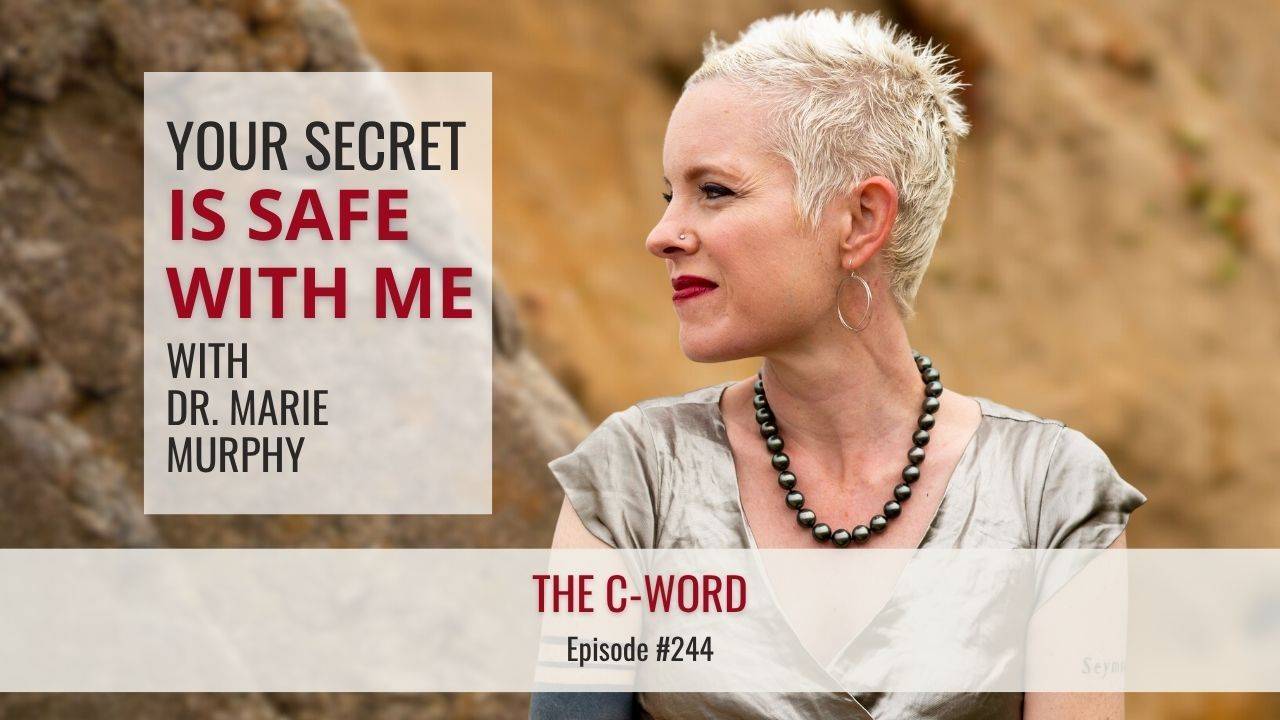
244: The C-Word
Oct 07, 2026What is the C-word? In my work, there’s one C-word that carries a lot of weight: closure.
When an affair ends abruptly or without the explanation you wanted, it can be incredibly tempting to believe that one more conversation, one more answer, or a different ending will finally allow you to move on. But what if your experience of closure doesn't actually depend on what your former affair partner does?
In this episode, I talk about what closure actually means, why we can end up making our sense of peace dependent on things we cannot control, and how our own thinking shapes whether or not we experience a sense of resolution. I also talk about the possibility that sometimes the best thing you can do is learn how to live without the answers you want.
Tune in to learn how you can create a sense of closure for yourself, or decide that you don't need closure to move forward. You may not like what happened, and you may never get the answers you want, but that doesn't mean you have to remain stuck waiting for someone else to give you peace.
Are you ready to resolve your infidelity situation in a way that’s truly right for you? If so, let’s get to work. There are two ways you can have me as your coach:
- You can enroll in You’re Not the Only One, my self-guided, online course that gives you the teachings and tools you need to resolve your infidelity situation in a way that you feel great about.
- If you want my personalized attention and support, we can work together one-on-one via Zoom.
Why wait any longer to find relief and a clear path forward? The rest of your life – beyond the drama and difficulties of your infidelity situation – is waiting for you!!
What You’ll Learn from this Episode:
- Why wanting closure doesn't necessarily mean you know what closure means to you.
- Why getting the answers or conversation you want may not actually give you closure.
- How your thinking contributes to your experience of closure.
- Why your affair partner doesn't owe you the ending you wish you'd received.
- How to create your own sense of closure after an affair ends.
- Why sometimes the better option is learning to live without answers.
- The difference between disliking an unresolved situation and believing it needs to be resolved.
Listen to the Full Episode:
Episodes Related to The C-Word:
- 86: When Your Affair Partner Ghosts You
- 216: When Your Affair Partner Breaks Your Heart
- 234: Resisting the Urge to Contact Your (Ex) Affair Partner
Featured on the Show:
-
Check out my brand-new YouTube channel!
-
If you want to submit a question for me to try and answer on the podcast, click here or email [email protected].
- If you have benefitted from this podcast, I would greatly appreciate it if you would rate and review the podcast, or send me a blurb about how it has been helpful to you. Click here to rate and review, or send your comments to [email protected]. Don’t forget to add your initials – real or fake!
Are you ready to resolve your infidelity situation in a way that you feel great about? There are two ways we can work together:
- You can purchase the DIY version of my program, You’re Not the Only One
- We can work together one-on-one
Resolving your infidelity situation may take some effort. And it is also totally do-able. Why stay stuck for any longer? Let’s find you some relief and a clear path forward, starting today.

Hi everyone, I’m Dr. Marie Murphy, and I’m a non-judgmental infidelity coach. If you are cheating on your partner, or having an affair, or you’re the “other person,” or you’re engaging in anything you think counts as infidelity, I can help you deal with your feelings, clarify what you want, and make decisions about what you’re going to do. No shame, no blame, no judgements. It really is possible to deal with your infidelity situation in a way that you feel great about, and I can help you do that. When you’re ready to work with me, there are two ways you can have me as your coach. We can work together one-on-one via Zoom, or you can enroll in my private, online course, You’re Not the Only One. To get started with either of those options, go to my website, mariemurphyphd.com.
This episode is going to come out in early October, and I just want to give those of you who are concerned about the holidays that happen in November, December, and January a little nudge. If you want to navigate the holiday season – and more specifically, the intersection between your infidelity situation and the holiday season – in a way that you feel good about, now is the time to get started. Now is the time to clarify what you want, and make changes in the service of what you want. You still have time to do this! But you don’t have time to waste. So either get to work on your own, or get started working with me. Time is moving right along.
All right, people. Today we are going to talk about a word that starts with C. And in my work, this word carries enough weight for me to call it THE C-word, although there are many words that we might refer to as such. The C-word that I am talking about is CLOSURE. And in my line of work, people often tell me they want closure after a relationship ends abruptly, and without a conclusion they consider satisfying, and of course, in my line of work, the relationship my client is talking about is usually an affair relationship, or a relationship that had some infidelity element to it. Now of course, people say they want closure in relation to other things, too. The abrupt end of any relationship – whether or not infidelity was a feature of the situation – can send people on a search for closure.
But what exactly is closure? You may say you want it, but do you have a clear sense of what it means? A lot of people tell me they want closure but they can’t define what closure is. OR they tell me they want closure, and they can define it, but their definition of closure is essentially the desire for a different outcome. For instance, sometimes people say they want closure after their affair partner ends their relationship with them, and the way they define closure is for their affair partner to leave their spouse and choose to be with them instead. And that’s a fair thing to want, but if that’s what you want, you’re basically saying that you want things to have turned out differently than how they did. And although there are many ways that people define closure, getting an outcome other than the one you got generally is NOT considered closure.
So how do we define closure? Here are two definitions of “closure” that I think are at least partially useful:
A sense of resolution after a significantly stressful event.
A clear answer or a peaceful ending to a painful situation.
I think these definitions are useful insofar as I think they speak to what many people are after when they talk about wanting “closure.” But I also think these definitions, and with them, the whole notion of closure itself, is problematic for several reasons.
If we make our experience of “closure” dependent upon things that we don’t have the power to control – like getting an explanation as to why someone broke up with us – we may never experience closure. And even if we DO get the things we want from other people, or other outside sources that we THINK will allow us to experience closure, we may not! And the reason for that is, our experience of closure – however we may define it – comes from our own thinking.
So let’s say your affair partner breaks up with you in a text message, and you say to yourself, okay, I can be okay with this relationship ending but only if I get to have one last conversation with my affair partner. You tell yourself, if I can have this one last conversation, I’ll have closure. Closure, closure, closure.
And your affair partner agrees to have one last conversation with you! And you think, great, this is what I need. But then you talk to them, and you find everything they say perplexing and unsatisfying. You ask them questions, and they answer your questions in ways you consider to be cold, or evasive, or avoidant. And then they end the conversation before you want it to end, and after it is over, you don’t feel any sense of closure at all. You got what you wanted – you had one last conversation with your affair partner! But you decided, based on how the conversation went, that it wasn’t satisfying, or wasn’t enough, or wasn’t what you needed. And therefore you don’t experience closure. But that’s based on your thinking! First, you set a moving target. You told yourself that you just needed to have a conversation with your ex-affair partner in order to have closure, but as soon as you got that, you set the bar higher. And second, you decided their comments weren’t enough. That’s a matter of your own thinking – it’s not some objective truth that you’re neutrally observing.
What’s the alternative, you ask? You could have said to yourself, okay, I got my one last conversation with them, which was what I wanted and I’m going to make peace with what I got out of that one conversation. I may not like what they said, but I got to talk to them, so I’m going to consider that enough. You could decide that even if you don’t understand their reasons for ending the relationship, understanding their reasons isn’t really the point: they’ve chosen to end the relationship, and that is the main thing, and whether or not you understand their reasons or like their reasons isn’t really the point. The point is that now you get to digest your own thoughts and feelings about the relationship ending. That way of thinking might bring you “closure,” or it might put you on the path to experiencing closure, or something like it.
So one of the critical points that we often miss about closure is that it comes from our thinking. Not from other people’s actions or inactions. Not directly, anyway.
And this is actually great news, because we have a LOT more control over our own thinking than we have over other people’s behavior. We may not get to have one last conversation with our affair partner. If we do, they may not say the things we’d like them to say. But we CAN consciously choose what we think about the end of our relationship with them, and however that ending occurred, and whatever they did or didn’t do. We may need to do some grieving first, but eventually, we can choose to think about the relationship and its end in a way that allows us to experience a sense of resolution and peace, or however we conceive of closure.
Now, I do want to point out that SOMETIMES it works out that other people respond to a stressful event – like the end of a relationship, for instance – in a way that we consider pretty darn good, and when that happens, that’s lovely. If your affair partner ghosts you then comes back and says, “You know what, I really owe you one last conversation, I’m sorry I disappeared suddenly, and I love you deeply but I cannot continue my relationship with you,” and that happens to be exactly what you wanted to hear, that’s great. That kind of thing can and does happen, and when it does, it can be really nice.
The problem, though – or ONE problem, anyway – is that some of us have gotten the idea that we are ENTITLED to other people doing things that we think will give us closure. And as I’ve been saying, that isn’t how it works, because even if someone does what we think will give us closure, it’s really up to us and OUR THINKING to give ourselves closure.
And in addition to that, it is not incumbent upon other people to do exactly what we want them to do, or think they should do. Your affair partner does not owe you whatever you consider to be a perfectly executed breakup. Now, for the record, I am all in favor of breaking up with people as clearly and compassionately as possible, but just because I think it’s a good idea to do what you can to execute a breakup in a particular way doesn’t mean that everyone’s going to do that. And just because you think your affair partner should do things in a certain way, that doesn’t mean that you are objectively, fundamentally right about what they should do, and it does not mean that you are entitled to get the behavior from them that you think you should get.
It’s not unreasonable to want things from other people. But it isn’t helpful to believe that our preferences for how other people behave are the absolute standards for how everyone should behave. In case you haven’t noticed yet, humans can do whatever they want, and they avail themselves of that opportunity ALL THE TIME.
So if you are hurting because a relationship that you cared about has ended, and if you have been telling yourself you want closure, I encourage you to clarify what closure means to you, and why you want it. And then you can either figure out how you might go about creating closure for yourself, or learn how to live without closure.
I’m going to say a little more about both of those options.
If you want closure and you have a clear sense of what that means to you, you can go about creating that for yourself in a number of ways. Let’s say your affair partner ghosted you. Let’s say the two of you had been together for a few years, and you loved each other, and you had what you considered to be a really important relationship. And then one day they just stopped calling, stopped texting, stopped taking your calls, and the whole bit.
You COULD decide that you have received more than enough information about where your affair partner stands in regards to your relationship. If they have gone incommunicado on you, and you know for a fact that they aren’t dead, the material fact may be that they have gone completely silent. You could decide that no matter what their intentions were or are, their behavior is enough for you to consider the relationship over. And you may not like that, but you may still be certain of your own assessment. No show no call no job. Right? You might not want to let it be any more complicated than that. Sure, you might love to know WHY they suddenly ghosted you after years of close connection, but you might also decide that you can live without that knowledge. With grief, perhaps, but without believing that you cannot have peace unless you know why they did what they did.
In doing that, you have created your own answers, and you have put yourself on a path to feeling better. And sometimes, that’s a pretty good version of closure.
Now, it’s also possible that you might want to try to have a conversation with your affair partner. Maybe you have clear reasons that you like for at least trying to talk to them one more time. That’s fair enough. And you might deem it appropriate to attempt to have this conversation by doing things that you didn’t normally do within your affair relationship. For instance, you might choose to show up at their work and say, hey, I’d really like to talk to you, can we please go get a cup of coffee?
And maybe they’ll say yes, and you’ll have a conversation, and you will decide that that’s enough for you, and by thinking that way, you will experience closure, or at least, get yourself heading in that direction.
But they also might refuse to talk to you. And you COULD take that as a definitive answer. You could say to yourself, well, I made it evident that I really wanted to talk to them, and they refused, so I guess that means it’s time for me to mourn this loss and move through my pain and then get on with my life. That too could put you on the path to peace. But you could ALSO make this sort of incident fuel for more self-torment. You could take it as a terrible offense that they wouldn’t engage with you. You could ask yourself even more questions about what they’re thinking, and why they did what they did, and so on. You could come up with more reasons for why you need closure, or why you now need even more closure than you did before, or whatever. And this, perhaps obviously, will only add to your woes.
If you think you want closure and you’re struggling with getting it, let’s talk. This is something we can work on one-on-one, so schedule an introductory coaching session with me if you want closure but you’re finding it elusive. My online course, You’re Not the Only One, is great, but it does not contain specific guidance on how to create closure for yourself. So if closure is what you seek and you can’t seem to find it, let’s talk specifically about what you want and how you can create it for yourself.
Now, I also want to propose that there are times in life when seeking closure might not serve you all that well. There are times in life when it may make a lot more sense to completely do away with the notion of closure, and instead, focus on building your capacity to live with the unknown. I know you may not like the idea of doing that! A lot of us don’t like the idea of doing that!
But we live in a world in which many things will forever be unknown to us. We live in a world in which events that are important to us may never reach what we might consider a resolution. If you’ve been listening to this podcast consistently you know that I’ve been living in Tucson for the last six-ish months, and I got here not too long after the height of the excitement over Nancy Guthrie’s disappearance had started to settle down. If you have no idea what I’m talking about, Nancy Guthrie is the mother of Savannah Guthrie, who is a famous person on television. I had zero knowledge of who she was until her mother disappeared, but apparently, she’s a very well-known public figure or celebrity or something like that. And her elderly mother disappeared from her home one night, and I think as far as anyone can tell, she was kidnapped, but the authorities aren’t sure what happened, and although Nancy is presumed dead, she has not been found, dead or alive. There were a bunch of ransom notes, but I don’t think any of them led to anything. And although I may not be up to date on all of the latest theories and information, as far as I know, they don’t have any leads on who might have kidnapped her or why they did it. And as far as I know, no one has contacted the family and said anything along the lines of, look, we have her remains, this is really shitty, but give us five million dollars and we’ll give you her body. In other words, a situation that many of us would consider pretty awful, and no answers. Maybe not even any credible leads towards answers.
If you’re the child of Nancy Guthrie – or otherwise related to her, or close to her in any way – is finding closure what you want to do, at this point? Maybe it depends on how you define closure. But maybe looking for closure – at least, by most definitions of closure - isn’t the point. Maybe the point is to learn how to live with the unknown and possibly unknowable. Maybe the point is to learn how to live with a tragedy that you previously considered unfathomable. Maybe the point is to build your capacity to live without answers, even if you never stop longing for answers. Maybe the point is to learn how to bear what you might previously have considered unbearable. I think of these endeavors as qualitatively different from pursuing closure, and significantly so.
Both similarly and not similarly, think of the families and friends of the people who were aboard Malaysia Airlines flight 370. If you don’t know what I’m referring to, this example actually is worth Googling, although I advise you to use keen discretion about what you information you consume on this matter. Briefly, if you don’t know, Malaysia Airlines flight 370 was a flight that disappeared in 2014. A mind-blowing, unprecedented occurrence. Although they’ve found bits and pieces of the plane, to my knowledge, there still isn’t consensus about where the plane went down, and what exactly happened to the flight and everyone on it.
If one definition of closure is, a clear answer after a painful situation, the loved ones of the people who were on that flight may never experience closure. As much as they may really want to know what happened to that flight – and frankly, I would very much like to know what happened to that flight – they may never get any clear answers. They might, but they also might not.
So again, maybe the path to peace – or something akin to peace – lies in learning how to live without answers, rather than believing that we can’t be satisfied until we have them.
These two examples – Nancy Guthrie and Malaysia Airlines flight 370 – captivated the media’s attention for a long time, and remain at least somewhat fascinating to a segment of the general public. But there are so many other less sensational, but common examples of situations that may never be resolved to our satisfaction. Think of the thousands – maybe thousands upon thousands upon thousands – of political dissidents who have been “disappeared” by their governments. Think of their loved ones and the questions they’ve had to learn how to live with. Think of all of the people who have died estranged from someone they cared about. Think of all the people who have died in the midst of an ongoing argument with a loved one. Think of all of the people who have lost a loved one to suicide and have had absolutely no idea why the person who killed themselves did what they did.
These are not uncommon experiences – and these are just a handful of examples of situations in which we may never be able to get closure in the ways we usually conceive of closure.
Now I’m not bringing up these examples of situations in which closure, as we may define it, may be impossible to minimize your desire for a sense of closure, or to minimize what you’re experiencing in any way. Believe me, there have been times in my life when I wanted “closure,” and even though I probably couldn’t have defined what I meant by closure in those instances, I still wanted it very, very badly. And, along the lines of something I said earlier, “closure” is one of those things that we collectively talk about as if it’s something that’s reasonable to want, or even something that we are in fact entitled to! So we can all be forgiven for thinking that closure is a Thing, and that if we want it, we should be able to have it!
But, as Byron Katie says, when we argue with reality, we only lose 100% of the time. And as I like to add to that line of hers, when we argue with reality, not only do we lose 100% of the time, we also feel terrible 100% of the time. So even if it’s reasonable to want closure, beyond a certain point, hanging onto that desire may create a lot of suffering for you. We may never get the answers or the resolution we want. Believing that we’re entitled to getting them or that we have to have them may only add to our pain – which may already be considerable.
And in that vein, accepting that painful situations that can’t be explained or resolved are a common part of the human experience can help alleviate our pain. When we think we shouldn’t have to experience something we’re experiencing and find painful, we experience more pain. When we regard a painful experience as painful but part of the “normal” human experience, we can experience our pain very differently. We may do ourselves a great favor by embracing the possibility that we will encounter situations in life where we cannot find anything that might remotely resemble “closure.”
Now here’s a really important layer to all of this. I’m not suggesting that you have to like not having answers to questions you would really like answers to. I’m not suggesting that you have to just feel fine about painful occurrences in your life. If your affair partner ghosted you and you do not like that, that is LEGITIMATE.
But interestingly, there’s an enormous difference between allowing yourself to acknowledge that you don’t like something, and believing that you need to know exactly why that something happened before you can possibly be okay. There is an enormous difference between disliking something that is unresolved and believing that thing NEEDS to be resolved.
This is a whole podcast episode in and of itself, and it’s one I’ve been meaning to create for a very long time, and it’s on the list of topics that I will get to eventually. But for today’s purposes, let me say this: relinquishing your need for closure doesn’t mean that you have to instantly feel even remotely good – or even remotely okay - about the situation that’s bothering you. Rather, it means that you find another way of relating to what you are experiencing, which may include some significant emotional discomfort.
And I can help you do this. I can help you create a sense of closure that serves you well, or learn how to live without closure if that makes more sense for your situation. We all need a wise guide to help us navigate life’s challenges and mysteries, and I am here to help guide you through the challenging aspects of your infidelity situation. And to help you celebrate the joyful aspects of your infidelity situation! To start working with me one-on-one, schedule an introductory coaching session with me. You can do that through my website, mariemurphyphd.com, and that’s also where you can enroll in my online course, You’re Not the Only One.
And that is it for today! Thank you all so much for listening! Bye for now.
Enjoy the Show?
-
Don’t miss an episode, follow the podcast on Apple Podcasts or Spotify.
Ready to talk?
Schedule your introductory coaching session with Marie.
Want the answers to your questions?
Sign up to get the free guide to the podcast, which shares the exact episodes you need to tune into to get started answering the questions you have about your infidelity situation.
We hate SPAM. We will never sell your information, for any reason.

Hi, I'm Marie!
I’ve helped hundreds of people successfully resolve their infidelity situations. I can help you resolve your infidelity situation in a way that’s truly right for you, too.