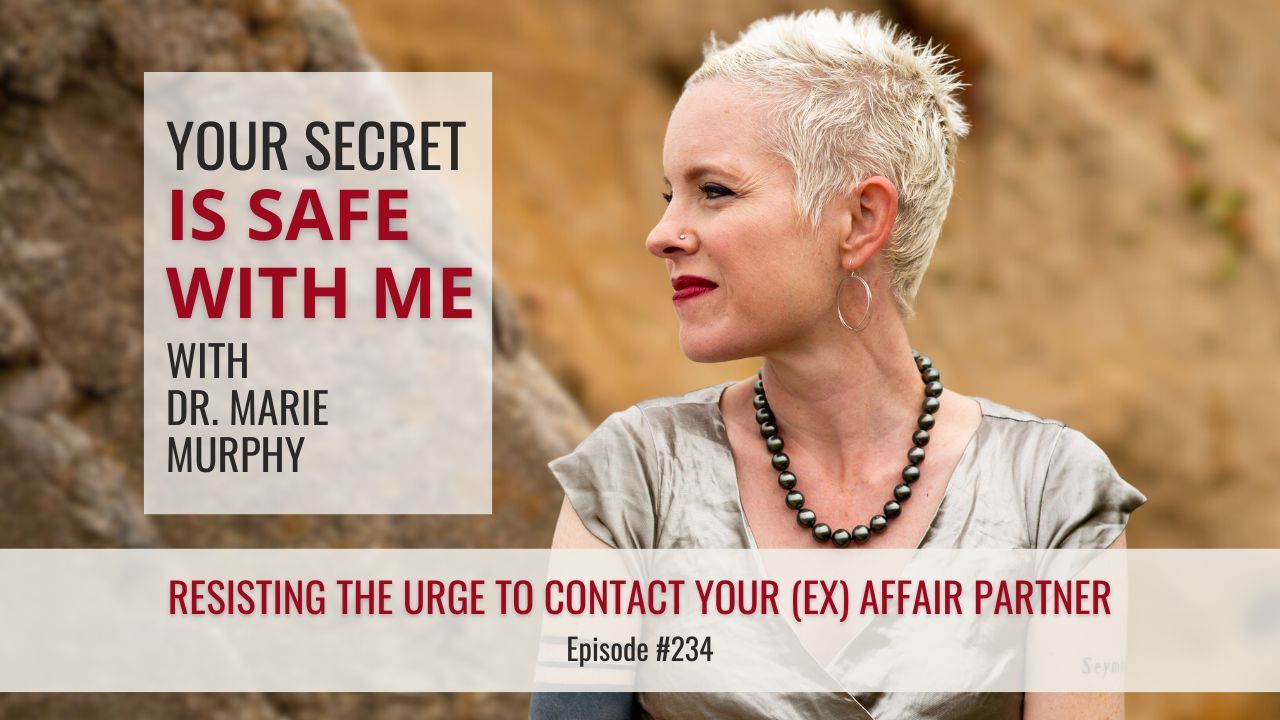
234: Resisting the Urge to Contact Your (Ex) Affair Partner
May 20, 2026What do you do when you’ve decided you don’t want to continue your affair, but you still desperately want to contact your affair partner?
So many people assume that if they truly wanted the relationship to end, they wouldn’t feel the urge to reach out. But what if those urges don’t mean you made the wrong decision at all?
In this episode, I talk about why learning how to tolerate the urge to contact your affair partner is very different from resisting or fighting the urge.
I explain why urges to reconnect are often the result of habit, emotional conditioning, and the brain’s desire for familiar rewards, rather than proof that you should restart the relationship. I also walk you through why it’s essential to make a clear decision about whether you actually want the relationship to end before trying to cut off contact.
You’ll learn how to contact your affair partner less impulsively by becoming more aware of the physical sensations that accompany urges, rather than immediately reacting to them. This episode will help you understand how to allow difficult emotions without acting on them, why urges lose power when you stop resisting them, and how practicing this skill can give you more freedom, self-trust, and clarity in your decisions.
Are you ready to resolve your infidelity situation in a way that’s truly right for you? If so, let’s get to work. There are two ways you can have me as your coach:
- You can enroll in You’re Not the Only One, my self-guided, online course that gives you the teachings and tools you need to resolve your infidelity situation in a way that you feel great about.
- If you want my personalized attention and support, we can work together one-on-one via Zoom.
Why wait any longer to find relief and a clear path forward? The rest of your life – beyond the drama and difficulties of your infidelity situation – is waiting for you!!
What You’ll Learn from this Episode:
- Why deciding to end your affair does not automatically eliminate the urge to contact your affair partner.
- The importance of making a clear decision before trying to cut off communication.
- How your brain can become conditioned to seek the “reward” of communicating with your affair partner.
- Why urges to contact your affair partner do not necessarily mean you made the wrong decision.
- The difference between resisting an urge and allowing an urge without acting on it.
- How to recognize urges as temporary sensations rather than emergencies that require action.
- Why tuning into physical sensations can help you contact your affair partner less impulsively.
- How practicing urge tolerance can strengthen your ability to stick to your goals.
- Why learning to allow urges without acting on them creates more freedom and self-trust.
Listen to the Full Episode:
Episodes Related to Contacting Your (Ex) Affair Partner:
Featured on the Show:
-
Check out my brand-new YouTube channel!
-
If you want to submit a question for me to try and answer on the podcast, click here or email [email protected].
- If you have benefitted from this podcast, I would greatly appreciate it if you would rate and review the podcast, or send me a blurb about how it has been helpful to you. Click here to rate and review, or send your comments to [email protected]. Don’t forget to add your initials – real or fake!
Are you ready to resolve your infidelity situation in a way that you feel great about? There are two ways we can work together:
- You can purchase the DIY version of my program, You’re Not the Only One
- We can work together one-on-one
Resolving your infidelity situation may take some effort. And it is also totally do-able. Why stay stuck for any longer? Let’s find you some relief and a clear path forward, starting today.

Hi everyone, I’m Dr. Marie Murphy, and I’m a non-judgmental infidelity coach. If you are having an affair, or cheating on your partner, or engaging in anything you think counts as infidelity, I can help you deal with your feelings, clarify what you want, and make decisions about what you’re going to do. No shame, no blame, no judgments. One of the things I often hear from new clients is, “I wish I’d started working with you a lot sooner.” And so what I want you to consider is, if your infidelity situation is the source of any angst at all for you, let’s start working together now and find you some relief and a clear path forward. You don’t have to wait for things to get worse before you start to do what you can to make things better. If you want my help dealing with your infidelity situation in a way that’s truly right for you, there are two ways you can have me as your coach. You can enroll in my online course, You’re Not the Only One, or we can work together one-on-one via Zoom. To get started with either of these options, go to my website, mariemurphyphd.com.
All right people, the title of today’s episode is clickbait. Kind of. We’re not going to talk about how you RESIST the urge to contact your ex-affair partner, or the person who you want to be your ex-affair partner but still kind of is your affair partner. We’re going to talk about how you can TOLERATE that urge without acting on it. Or better yet, how you can allow, or even embrace the urge to contact your affair partner without acting on it. When we talk about urges, we often speak in terms of resisting urges, or fighting off urges – or distracting ourselves from our urges. And today I’m going to tell you why it’s so useful to learn how to tolerate, or allow urges, and why the difference between allowing an urge or tolerating an urge, and resisting an urge is not just a semantic distinction.
Before we actually talk about tolerating the urge to contact your affair partner, we need to talk about a distinct yet related matter. And that is, your decision to cease contact with your affair partner. If you have not yet made a clear decision to cease contact with your affair partner for reasons that you like, don’t bother trying to cut off contact with them. Make a firm decision that you’re willing to commit to first. Here’s why this is important.
A lot of people come to me and say, “I’ve been trying really hard to cut off all contact with my affair partner and I keep failing. I just haven’t been able to do it.” And, upon a minimal amount of questioning, what becomes clear is the person I’m talking to doesn’t actually WANT to cut off contact with their affair partner. They don’t actually WANT to end their relationship with them! So before you even try to cut off contact with your affair partner, I want you to be really honest with yourself. DO you want to cease contact with them? If you don’t, don’t bother trying. You probably need to solve for something else first, or you may need to solve for an entirely different thing.
If you are sure that you want to end your relationship with your affair partner and cease contact with them, I want you to be really, really clear on your reasons WHY you want to do this. If you have listened to this podcast for a while, you have probably heard me talk about this a lot. Our reasons are like rocket fuel. Knowing that we want to do something – or not do something – is important. But having clear reasons that we like for our decisions helps us commit to our decisions, and stick to our decisions, even when we find it difficult to do so. And this is important because even if you have decided that you want to end your relationship with your affair partner, and stop communicating with them, you may not find it easy or pleasant to stick with this choice. At times, anyway. And that isn’t a problem, but you need to be intellectually prepared for this to happen, and you need to be clear on why you want to stick to your decision even when it doesn’t feel easy or fun to do so.
That said, I want to be 100% clear about something right now: having decided that you want to end your relationship with your affair partner and stop communicating with them will not necessarily prevent you from feeling the urge to contact them. Or from feeling the urge to respond to them if they contact you.
And that is because even if you are as sure as you can possibly be that you want your relationship with your affair partner to be over, and you believe that not communicating with them is the best possible course of action for you, you may still have feelings for this person! You might still have a LOT of feelings for this person, and they might be very strong feelings! So two very important things might be true for you at once: you want the relationship to be over, and you still yearn for your affair partner. The former may not cancel out the latter.
And if that’s happening for you, that isn’t an indication that anything has gone wrong. When a relationship ends, our brains don’t automatically and instantly delete all of the thoughts we had about the person we were in a relationship with. You may still have a lot of good thoughts about your affair partner, even if you’re as sure as you can be that you don’t want to continue your relationship with them.
And that’s not a problem! It’s okay to decide to end a relationship, and miss them and yearn for them and feel desire for them after you do so. Two seemingly conflicting things can be true at once: you can be sure you want to end a relationship, and you can still like a lot of things about that relationship. The problem occurs when we think that missing someone we’ve decided to end a relationship with is an indication that we shouldn’t have ended the relationship. Or, if we start to feel regret for ending our relationship with our affair partner, we often treat that as a sign that we made a MISTAKE, and that we need to DO something to correct that mistake. Or, if we still want to have sex with the person we’ve ended a relationship with, we make that mean that we shouldn’t have ended the relationship – at least, not yet. And that kind of thinking is what gets us into trouble. Even though we have consciously decided that we really do want our relationship with this particular person to be over, in a moment of missing them, we may feel the urge to contact them, and if we act on that urge, well, before we know it, we’ve started our affair back up again. If we want to have sex with someone just one more time, we may pursue that, and then there’s another time after that, and another time after that, and the relationship that you decided to end effectively continues. And you might not want that!
It’s also important to be aware that even if you don’t miss your affair partner terribly, you still may be in the habit of expecting to get a certain hit out of communicating with them. For weeks, or months, or years, you may have been in the habit of reaching out to your affair partner, engaging with them, and getting something enjoyable out of that experience. You have, quite possibly, come to rely on your affair partner as a reliable source of good feelings. Your brain has learned, in so many words, that if you put the money into the vending machine, a treat will come out. I’m not saying that your relationship with your affair partner was nothing more than a source of instant gratification, but I am saying that communicating with them probably did provide you with some instant gratification. Even if the two of you were fighting all of the time when you decided to end the relationship, even if your interactions were acrimonious just as often as they were otherwise, your brain may have liked the drama of that. And our brains may like the drama of fighting with someone more than being bored.
So even if you aren’t consciously longing for your affair partner, even if you aren’t actively sad about your relationship being over, you may still miss communicating with them to a certain degree. Perhaps it’s just the entertainment you got out of communicating with them, but in any case, you miss it. Because your brain wants its usual treat! Or even if you don’t think you’re actively seeking a treat, in a moment of boredom, you may not want to be bored anymore! And, metaphorically speaking, the vending machine full of treats is right there, beckoning you! You COULD just text your affair partner, and you know they’d probably respond! And even if you have decided, on one level, that you don’t want to continue your relationship with them, on another level, you may really, really, really just want the hit that you’ll get out of communicating with them in that moment. Or simply texting them, even if they don’t respond! You may know that reaching out to them will not serve the decisions you’ve made, but in the moment of wanting to reach out to them, you may not care! In any given moment, you may just want to do the thing that you think is going to make you feel good!
If you’ve ever quit a habit that you really liked – at least in some ways - because you didn’t like some of the consequences of that habit, you have a sense of what I’m talking about. To extent, what I’m talking about is the same as quitting smoking or quitting drinking or quitting online gambling or getting a handle on overeating or any other habit that we both like and don’t like. Having a few drinks might feel great, but the next day you might not feel great. You may love the ritual of smoking and the physiological effects of smoking, but you just don’t want to chance the health consequences that can come with smoking. You love the rush of online gambling, but you don’t love the financial consequences of your gambling habit. But just because you’ve gotten to the point where you have decided that the drawbacks of your habit outweigh its benefits, that doesn’t mean you automatically stop wanting to engage in the habit.
And I want you to consider that this is not a problem. Deciding to stop doing something and wanting to do it anyway doesn’t have to be a problem. Sometimes people tell me, “Well, it’s a problem for me because it’s hard for me!” But why is THAT a problem? What if some things are just hard? I want you to consider that when we drop the expectation that something should be easy, or easier, everything changes. And, interestingly, when we drop the expectation that something should be easy, it often gets a little easier. Or at least a little less torturous.
So with that important background established, here’s how you deal with the urge to contact your affair partner. Here’s how you practice allowing yourself to feel the urge to contact them without acting on that urge.
Here’s what will happen. You’ll be going about your day, doing whatever you do, and boom, you’ll find yourself thinking about your affair partner. Maybe you’ll start missing them. Maybe you’ll start wondering what they’re doing. Maybe you’ll tell yourself that you really NEED TO KNOW what they’re doing in that very moment. Maybe you’ll wonder if they’re thinking about you. Maybe you’ll wonder if they’ve started dating someone else, or reconnected with their primary partner. Maybe you’ll tell yourself that you absolutely have to know, right now, whether or not they still love you. Maybe you’ll decide that if you don’t have sex with them just one last time you will DIE. If you’re thinking and feeling any of these things, you may quickly come to the conclusion that you NEED to contact your affair partner immediately. And then you will feel the urge to do that. And that urge may seem like a sign that you MUST take action, and do the thing that you want to do!
Or maybe you’ll just be at that point in your day when you would usually be with them, or talking to them, or texting with them, and the absence of that contact just feels weird. You may not miss them terribly, but you miss the ritual of connecting with them, or, you simply don’t know what to do with yourself in the absence of connecting with them in a familiar way. Instead of getting the treat from the vending machine that you’re used to getting, you’re contending with a big hole in your day instead. And that might seem like a problem. Maybe not a catastrophic problem, but still, a problem. And often, when we think of something as a problem, we want to fix the problem. And contacting your affair partner might seem like a GREAT solution to this problem. So you feel the urge to actually do it!
There is absolutely nothing wrong with feeling these kinds of urges. This is where a lot of misconceptions lie. Some people will tell you that feeling the urge in the first place is an indication that you’ve done something wrong – like, for instance, that choosing to end the relationship was the wrong decision. Some people will tell you that if you really want a relationship to end, you wouldn’t feel the urge to contact the person you’re breaking things off with. But this is NOT necessarily the case, for the reasons I’ve described, and for some others. So I want you to recognize the urges you may feel as habitual programming that’s been in your system for a long time. It’s like when you reorganize your kitchen and you continue to open the cupboard that used to hold the cups when you’re looking for a cup, even though you’ve put plates in that cupboard. For a while, you may automatically go looking for the cups where the cups used to be. This might be kind of annoying, but it doesn’t have to be a big deal.
So: your urges to contact your affair partner are not a problem! Please do not scold yourself for feeling these urges! Please do not tell yourself that you should not have these urges! Please do not try to repress or deny these urges! It won’t work very well, for one thing, but for another thing, it isn’t necessary.
What’s the alternative, you ask? It’s very simple, but it isn’t something we’re used to doing.
The alternative is to be really, really present with and curious about the urge that you’re feeling.
When you notice that you want to contact your affair partner, what does that feel like in your body?
I know you’ll probably want to answer that question by narrating what’s going on in your mind. When I ask people how an urge feels in their body, they usually say something like, “Well, I’m really afraid that my affair partner is having a terrible time since we aren’t in contact, and I just need to know they’re okay, so that’s why I have to contact them.”
The practice isn’t to explain to yourself why you want to contact them.
The practice is to tune into the physical sensations you are experiencing when you experience that urge, or that desire, or that supposed need.
Most of us are NOT in the habit of tuning into the physical experience of our emotions – and an urge is an emotion – so this may seem awkward, or even impossible, at first.
And that’s okay. The point isn’t that you need to be good at doing this right way. The point is that you can practice tuning into the physical sensations you’re experiencing, and turning your focus away from your thinking. You can practice this again and again and again until it becomes a habit.
I know that some of you listening are thinking to yourselves, “WHAT is she even talking about? It is impossible to turn my focus away from my thinking. I am a thinking machine! All I do is think! I think and I think and I think and I think! My entire experience of being alive happens between my ears! Except for when I experience pleasurable sensations in my genitals! How on earth does one shift their focus away from their thinking, and feel the sensations in their body? I don’t feel any sensations in my body!”
If that’s you, I get it. I was very much this way too for most of my life. Even as a kid, my poor little brain worked on overtime. But even for those of us who have a long history of living inside of our minds, it is possible to learn how to use our power to think more selectively. It is possible to learn how to tune into other layers of our experience of being alive – beyond just our cognitive experience of being alive. And we stand to benefit greatly from doing this.
What does it mean to tune into the physical sensations of an urge? Well, it means to notice what we feel in our bodies when we want to do something.
So, for example, as I’ve been sitting here putting together notes on this podcast episode, I’ve wanted to do something else at least a dozen times. And it’s not because I don’t want to put together my notes for this episode! That’s not the problem at all. The problem is that my tantrum-throwing brain wants a treat. What kind of a treat? ANY kind of a treat. Maybe I need to check my email. That could be exciting. Maybe I need to go to the bathroom, even though I know I actually don’t. Maybe I need to go get some water! THAT sounds like a very legitimate reason to get up and find a little relief from the effort it takes to focus on the task at hand. But do I actually NEED some water right now? No.
But as I think about all of these things I could do, I feel a strong urge to do them. And what that feels like in my body is restlessness. My limbs feel a little twitchy. My neck feels kind of tight. I feel my heart rate speeding up, which makes sense, because in the silliest regions of my brain, sitting at my desk right now and focusing on my work seems like a terrible fate that I MUST ESCAPE NOW. Ugh. Even as I’m saying that, I feel my heart rate speed up and my stomach drop.
But here’s the thing. I haven’t checked my email. I haven’t gotten up to go to the bathroom. I haven’t gotten any water. I’ve allowed myself to feel all of the sensations that come with the emotion of urgency. And I haven’t acted on the urges.
Now, has it been comfortable to do this? No, not really. I don’t like feeling my heart rate speed up and my stomach drop. I don’t really like feeling twitchy. I don’t really like feeling like there is energy inside me that must be dispersed but can’t be. No, thank you. But I can tolerate all of these sensations. I can allow myself to feel these particular flavors of discomfort without believing that I have to make them go away. I can allow these sensations to move through me – or, I can allow myself to move through them – which is what happens when I just let them come, without resisting them or avoiding them.
Practicing this, practicing relating to our urges in this way is really, really simple. It may seem complicated, but it isn’t. It’s just probably very different from what you’re used to doing.
So when the urge to contact your affair partner arises, you can say to yourself, “Okay, here we go. It’s happening. I am feeling the desire to contact my affair partner. I feel an urgent need to contact them. All right. What do I notice happening in my body? Can I identify the sensations I’m experiencing? What do they feel like? Where are they located? Are they lasting a long time, or have they already started to change?”
If you practice doing this, what you will start to notice is that if you allow yourself to feel the physical sensations of the urge without resisting the sensations, and without THINKING about what is going on, the urge will come and it will go. Or at least, it will lessen in intensity, and possibly pretty quickly. And here’s the really cool part: when the sensations of the urge start to dissipate, what seemed like an emergency two minutes ago doesn’t seem like an emergency anymore. What seemed like a problem that needed to be solved doesn’t seem like that anymore.
It’s like, “Oh, two minutes ago, I thought I HAD to call my affair partner to find out what they were doing, and I really believed that if I didn’t do that, I would explode. But… I tolerated the urge, I felt my way through the discomfort without acting on it, and I didn’t explode, and now, I don’t see any reason to call my affair partner anymore. I’m free!”
OR, “Oh, wow, a moment ago, I really wanted a cigarette, and I thought that I literally needed a cigarette to continue EXISTING. But I didn’t have one, and not only am I perfectly fine without one, I’m also really proud of myself for sticking to my plan to not smoke anymore, or not smoke right now, or whatever.”
But we have to prove to ourselves that this really does work like I’m describing it. We have to show ourselves, by being willing to feel the urge to contact our affair partner without acting on it, that the world will not end if we do not do the thing we feel the urge to do. When we can get through the urge – meaning, when we can allow ourselves to feel the sensations of the urge without acting on them – we show ourselves that we didn’t actually have to do the thing we thought we had to do.
There are many rewards for allowing ourselves to feel our urges without acting on them, but I’m going to emphasize two. The first is that we get to stick to our goals. If you want to refrain from communicating with your affair partner – ex-affair partner – you have to allow yourself to just feel the urge to contact them or respond to them without acting on it. If I want to put together a podcast episode – instead of squandering the time I set aside to do that – I have to allow myself to feel the urge to do any number of things that could distract me from the task I’ve willingly chosen for myself. If you want to quit drinking, you have to allow yourself to feel the urge to have a drink without actually drinking. If you want to eat less sugar, you have to allow yourself to feel the desire to eat the cupcake without actually eating the cupcake. And then you get all of the benefits of not eating the cupcake, or not having the drink, or not succumbing to distraction.
The second reward for allowing ourselves to feel our urges without acting on them is that the more we practice this, the more we gain freedom through mastery over our impulses. Our brains can easily want to do a zillion things in a day. But if we let our brains and their sometimes-crazy impulses dictate our lives, we may not like what happens. When we learn how to allow our urges, or tolerate our urges, we give ourselves the opportunity to more consciously decide what we want to do with ourselves and our precious time and energy – rather than just being a slave to our impulses. Slave is a strong word, I know. But sometimes it’s a pretty apt way to describe the extent that we become beholden to our urges, or our impulses.
If you consistently practice tolerating and allowing urges without acting on them, the urges will probably lessen in intensity, and may go away entirely. If you allow your urges to eat cupcakes without acting on those urges, you may lose your desire to eat cupcakes. Entirely! It might not happen overnight, but it might happen, and it does happen. And sometimes we can decondition our urges pretty quickly, and when that happens, that’s delightful.
But when you are first practicing allowing yourself to feel the urge to contact your affair partner without acting on that urge, you will probably need to be very willing to be diligent. At first, allowing yourself to feel the urge to contact your affair partner without actually contacting them may feel like a herculean effort. And it’s okay if it does! Just keep going. Keep practicing allowing yourself to want to do the thing without doing the thing.
To echo what I said a little while ago, what you gain from doing this is the ability to act on your desires and urges in a conscious and deliberate way. And that’s how we gain the ability to create the kinds of relationships – and the kinds of lives – we want to experience.
This is why allowing an urge is so different from resisting an urge or fighting an urge or avoiding an urge. When we allow an urge and we don’t act on it, the urge starts to lose power. When we fight an urge or resist an urge or avoid an urge, the urge retains its power, and we never learn how to relate to the urge in a way that serves our goals, or our best intentions.
Now, let me just say a little something about practice vs. perfection. If you end up contacting your affair partner – even if you decided you want your relationship with them to be over, and that as such, you don’t want to communicate with them anymore – it’s not the end of the world. When it comes to learning how to allow our urges without acting on them, we may need to practice. Instant perfection is not the goal. Diligent dedication to the practice is. If you do end up acting on the urge to call your affair partner, you can dust yourself off and get back to the business of practicing allowing the urge without acting on it.
Now this is where some people say, “Well, what if I actually DO want to contact my affair partner? How do I know the difference between an urge that’s just old programming that’s still in the system, and a genuine desire to connect with them? Maybe I thought I wanted to end my relationship with them, but maybe now I’ve changed my mind. How do I know?”
Here’s my brief answer to that: practice allowing the urge without acting on it before you decide. Not just once or twice. The point is to get to a point where you can be reasonably sure you aren’t operating from a default allegiance to an urge, or from the desire to do something that reliably brought you pleasure in the past.
All right people, it’s one thing to listen to me talk about this stuff on the podcast, and it’s another thing to put my teachings to use in your own life. If you’re ready to start doing that, there are two ways I can help you. One is for you to enroll in my online course, You’re Not the Only One, which contains teachings and assignments that go beyond what I offer on the podcast. If you are ready to start dealing with your infidelity situation differently, and in a way that you feel good about, enroll in You’re Not the Only One, and I will help you find relief and a clear path forward. And if you want to work with me one-on-one via Zoom, schedule an introductory coaching session with me to get started. When we work together one-on-one you get all of my radical compassion and incomparable expertise focused on the specifics of your unique infidelity situation. To enroll in my course or to book an introductory coaching session, go to my website, mariemurphyphd.com.
Thank you all so much for listening! Bye for now.
Enjoy the Show?
-
Don’t miss an episode, follow the podcast on Apple Podcasts or Spotify.
Ready to talk?
Schedule your introductory coaching session with Marie.
Want the answers to your questions?
Sign up to get the free guide to the podcast, which shares the exact episodes you need to tune into to get started answering the questions you have about your infidelity situation.
We hate SPAM. We will never sell your information, for any reason.

Hi, I'm Marie!
I’ve helped hundreds of people successfully resolve their infidelity situations. I can help you resolve your infidelity situation in a way that’s truly right for you, too.