229: Radical Un-Shaming with David Bedrick
Mar 11, 2026Radical un-shaming sounds lovely in theory, but what does it actually look like when you are dealing with desires, behaviors, or parts of yourself that other people insist are unacceptable? And what happens when the experts, the culture, or even your own inner voice tell you that the answer is to suppress, pathologize, or condemn what is most difficult to face?
In this episode, I’m joined by author, teacher, and counselor David Bedrick to talk about shame, morality, psychology, and the limits of a therapeutic model that divides people into victims and perpetrators, good people and bad people.
Together, we explore how infidelity and other taboo experiences are so often approached through judgment rather than curiosity, and why that leaves so much of our humanity unseen.
Tune in this week to learn why radical un-shaming is not the same as excusing harmful behavior, and why compassion for all parties matters if we want real healing. We discuss the importance of curiosity and courage in facing the parts of ourselves we would rather reject, how a more whole and humane approach can deepen accountability, and why creating a less punitive culture may be essential if we want people to tell the truth about who they are and what they are struggling with.
Are you ready to resolve your infidelity situation in a way that’s truly right for you? If so, let’s get to work. There are two ways you can have me as your coach:
- You can enroll in You’re Not the Only One, my self-guided, online course that gives you the teachings and tools you need to resolve your infidelity situation in a way that you feel great about.
- If you want my personalized attention and support, we can work together one-on-one via Zoom.
Why wait any longer to find relief and a clear path forward? The rest of your life – beyond the drama and difficulties of your infidelity situation – is waiting for you!!
What You’ll Learn from this Episode:
-
How morality and psychology have combined to shame many common human experiences.
-
Why curiosity can be more useful than condemnation when confronting difficult desires.
-
What David means by an unshaming approach to suffering and behavior.
-
Why focusing only on the so-called injured party can limit healing.
-
How the victim-perpetrator framework can obscure the humanity of everyone involved.
-
What Carl Jung’s concept of the shadow can teach us about infidelity and shame.
-
Why suppressing unwanted parts of ourselves rarely leads to lasting change.
-
How curiosity and courage help people face what they would rather not see.
-
Why accountability does not require self-hatred or demonizing other people.
Listen to the Full Episode:
Episodes Related to Radical Un-Shaming:
Featured on the Show:
-
The Unshaming Way by David Bedrick
-
Check out my brand-new YouTube channel!
-
If you want to submit a question for me to try and answer on the podcast, click here or email [email protected].
- If you have benefitted from this podcast, I would greatly appreciate it if you would rate and review the podcast, or send me a blurb about how it has been helpful to you. Click here to rate and review, or send your comments to [email protected]. Don’t forget to add your initials – real or fake!
Are you ready to resolve your infidelity situation in a way that you feel great about? There are two ways we can work together:
- You can purchase the DIY version of my program, You’re Not the Only One
- We can work together one-on-one
Resolving your infidelity situation may take some effort. And it is also totally do-able. Why stay stuck for any longer? Let’s find you some relief and a clear path forward, starting today.

Hi everyone. I'm Dr. Marie Murphy and I'm a non-judgmental infidelity coach. If you are having an affair or cheating on your partner or engaging in anything that you think counts as infidelity, I can help you deal with your feelings, clarify what you want, and make decisions about what you're going to do. No shame, no blame, no judgments. When you are ready to start dealing with your infidelity situation in a way that's truly right for you, I can help you do it. To learn about how you can have me as your coach, go to my website, mariemurphyphd.com. I can't wait to meet you.
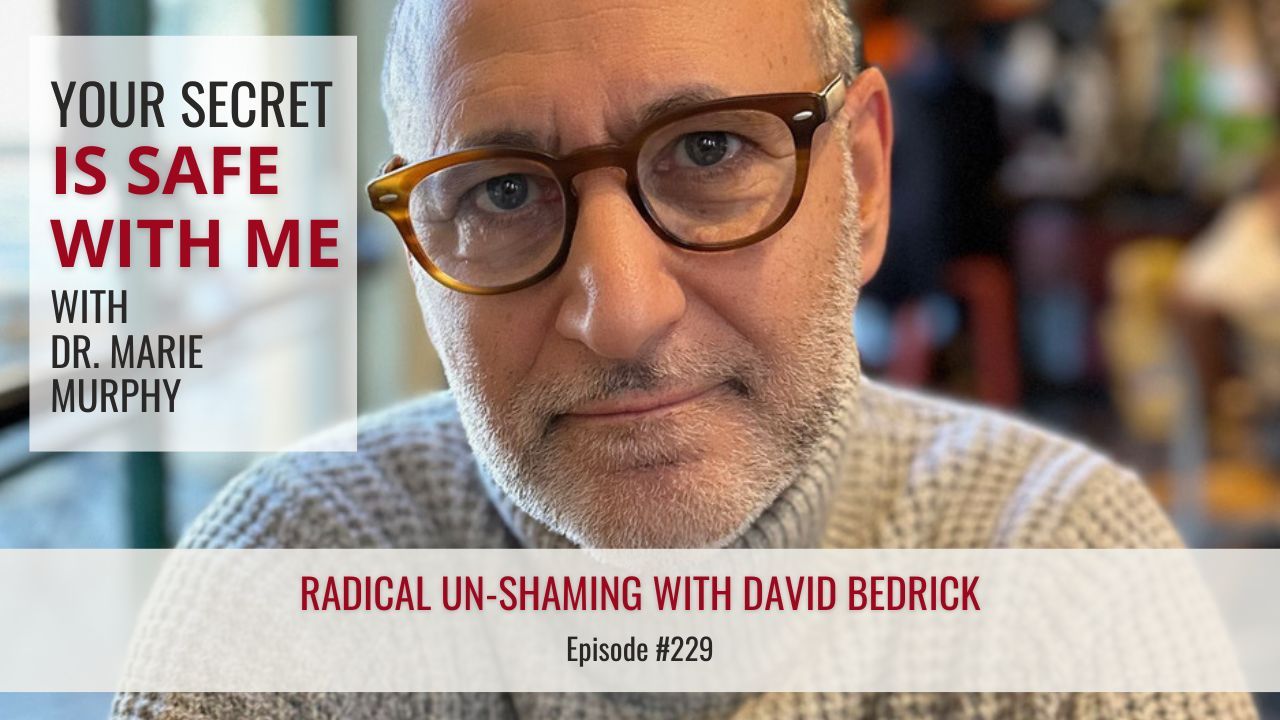
Marie Murphy: Today, I have the pleasure of talking with David Bedrick. David is an author, counselor, teacher, and attorney dedicated to transforming how we approach shame and suffering. He is the author of The Unshaming Way, a book lauded by Gabor Maté as a deep investigation of shame that offers a workable, practice-based, and accessible path to divesting ourselves from it. David's passion for this work stems from his own challenging childhood experiences. After 40 years of research and clinical practice, he founded the Santa Fe Institute for Shame-Based Studies, where he educates therapists, coaches, and healers. His unshaming paradigm treats life's difficulties as powerful invitations to insight, soul, and self-connection. David's embodied teaching style often brings students face to face with their own beauty and life purpose. A contributor to Psychology Today, he is also the author of three additional books with a new book coming in 2026. Hi, David. It's a pleasure having you on the show.
David Bedrick: Hi, Marie. Thank you. I hear that bio, I'm thinking, who's that?
Marie Murphy: Right? Who is this person?
David Bedrick: I don't know. It keeps changing. Every time I try to hold him down, he sneaks out.
Marie Murphy: Wriggles away.
David Bedrick: Exactly.
Marie Murphy: Yep. Yep.
Well, listen, there are approximately a million things that I would like to discuss with you. But let's start here. As we all know, I work with clients who are engaging in infidelity as they define it, and many of them, as you might imagine, have gotten the message that not only is engaging in infidelity really bad, but they've also gotten the message that because they are engaging in infidelity, they themselves are really bad. And often, people have been explicitly told this by some sort of credentialed expert. Maybe they've read an article or a book or dozens of articles or books written by so-called experts that proclaim the badness of infidelity and the badness of people who engage in infidelity. And also, sometimes people have been told this directly by a professional who they have hired to help them, like their therapist. And I want to get your take on how we got here. How did we get to a place where modern psychology or big psychology and the therapeutic industrial complex and the offshoots thereof got into the business of shaming human behaviors that A, are very common, and B, are very human?
David Bedrick: I'm thinking of two things when you ask, there's probably more, but the first thing is morality, whether that's Judeo-Christian morality. That would be foundational in Western thinking where most of what we think of psychology. Morality was not distinct from a lot of the viewpoints about what health looked like. Health with a tumor or something most people would agree with, although shamanic cultures might not. But health psychologically, gender issues, sexual preference, and identity issues filled with morality. This is good, this is bad. This is diagnosable, right? If you're a man loving another man and was sexually moved and turned on by that, that would be diagnosable at one point. So that's not an illness, that's a moral viewpoint, right? And that shot through ideas about normality.
And then medicine, psychology in the West again has a medicine as its root, Western medicine, European medicine, male patriarchal medicine at its white, white patriarchal medicine at its root. And that means if we can take something and remove it from you, then you're healed. So that's simple again, like an infection in my finger, if you can give me an antibiotic or put something ointment on it or do clean it up and the infection goes away, I'm healed. So that notion, the allopathic notion, healing means the removal of symptoms, as opposed to the investigation of symptoms for their intelligence meaning, learning about yourself. That dominates. So those two things dominate the healing space.
Marie Murphy: Yeah, let's talk a little bit more about what this means because I'm a sociologist by training. I studied the production of knowledge about sexuality and how, you know, the medical profession, you know, came to be what it is in the Western sense and how that influenced common thinking about human sexuality. So, I'm with you, but let's tease this out a little bit for folks who may not have a background like ours. You point to something really important. It's not just that morality infuses psychology and therapeutic thinking. It's a particular version of morality, right? It's a version of morality that sees good and bad and right and wrong. It sees black and white. It sees normal and abnormal. It's a very dualistic morality that has informed psychology, right?
David Bedrick: Yeah. I'm thinking as we're talking, I'm remembering a teacher, he was a therapist, but I called him a teacher because that's what his main function in my life was. But I remember telling him, his name was Arnie. I remember saying, Arnie, I was sitting in a cafe and I was attracted to this other woman. This is what I was attracted to. That's bad, I was feeling. What should I do about that? It was, I don't know if how I said that, but that was what I was, I'm confused. What do I do about that? I'm married for many years. And he said, "Oh, you were attracted. What did that feel like?" And I was like, oh my gosh. That's an interesting question. I wasn't thinking about that. And I was like, well, I don't know. It's confusing. It's upsetting.
And he said, "No, what does it feel like to be attracted? Not what does it feel like to be confused about it?" And that was really touches me. It was so beautiful and simple that he was interested in how in my body's experience of being turned on. What I should do with that we could talk about that, but just that aspect. So then if I, which I did, if I had a sense of that is not okay somehow in my idea of being married, that ought to be suppressed somehow, put aside, marginalized somehow, then where does that go? And what does that impact in my marriage? What does that impact as me as a person who's turned on by all kinds of things? Where does that energy go? Am I going to look for things online that turn me on? What am I going to do? Am I going to be a little bit more depressed that way? What will happen with that experience?
Marie Murphy: Yeah, and I mean, you work with more therapists than I do, but I work with a lot of clients who have been, shall we say, impacted by therapists who don't take that sort of approach, who don't say, okay, you're attracted to someone else or you're actually involved with someone else and yet you're in a committed relationship. What's that like for you? Instead, they say, uh-uh, just stop doing it. Let's remove that. Let's just excise that from the whole situation and then you'll be fine. And that's all they get.
David Bedrick: Yeah, that's difficult. I mean, for some people, that's going to be good medicine, I'm going to call it. Meaning their morality and ideas of religion and what's right and wrong are so strong that I'm not going to do anything that's going to open that as if it should be, right? Then that idea, this is what you should do to get rid of that, to make sure that doesn't happen so you don't injure your relationship and become a bad person. If that's super strong, I won't be able to mess with that with one caveat, if they're trying to, if they're insisting on some fundamental belief to live by, that's okay, and it doesn't work over and over and over, then at least I can hang on to that. Well, I'm not against your morality, but something in you doesn't go along about that. I can't tell you what you should do, but we should at least learn about what's actually happening. So that would be a doorway past, if we could say, the block of, this is right, this is wrong, I can't go any further. What are you thinking?
Marie Murphy: Yeah, yeah. I mean, so I'm looking for your comment on what you see in the world of therapy. I don't see, well, I mean, for me, most of this is second hand. It's me hearing my clients talk about their experience with their therapists, right? But what I see is that a lot of therapists can't get to the what's it like. They only get to this is wrong. Let's figure out how you can stop doing it. And what are your thoughts about, you know, how we got there and how can we get beyond that?
David Bedrick: Yeah. I mean, it's the therapeutic world and that's really important. And then the people who are coming to the therapeutic world, the coaches, the healers, the therapists, are coming with that paradigm already internalized, meaning, Marie, can you help me? As I did with Arnie. Can you help me? I'm doing something bad. And then if you don't challenge that in any way or see through that, then you'll be like, okay, let me help you, right? Can you help me lose 20 pounds? Okay, I'll help you. You won't say what am I eating, what do I love to eat. If I say I shouldn't be attracted to other women, it's messing up my marriage, etc., I'm doing these wrong things. Then you might not have a viewpoint that says, that's interesting. Let me really understand that deeper. Let me not only be glued and fixated on their presentation, but see use my professional insight, my knowledge, my wisdom to see through that so I can make sure I'm addressing the problem at a deeper level. If that's not happening, and many people that's not, then they're just going to be, okay, let's figure out how to do that. You know? What does self-containment do? Can you release your energy some way through running? So can you meditate maybe so you're calm down when you go outside? How are you going to be more detached about that? So right, take a deep breath when you're attractive to somebody. I don't know, that's facetious, but here's techniques and protocols that will help.
Marie Murphy: That's the thing. I mean, I think that you're really on to something there. I mean, like that is the kind of bullshit guidance I hear people having received over and over. Like, oh, you're attracted to someone else, just take a deep breath, move on, right?
David Bedrick: Yeah.
Marie Murphy: Yeah. And I bet you see this too amongst practitioners who you train.
David Bedrick: Yeah, for sure. And you're making me think my wife just got a doctorate and part of that was studying the internet and its effect on relationships and all this data about pornography. So then there's like this enormous culture that's probably always been, it just hasn't been the access, right? There's like enormous culture and under, you know, teens, maybe younger also, where this incredible access to enormous information images. You know, so it's like, so on some way then still, I'm loyal to a certain view. Now it's not only a person, maybe I'm 16 and I'm not married to anybody or going study or whatever, but I'm loyal to a certain view, but then off to the side, right, if we were Jungian, we'd say in the shadows, whoever you want to call that, split off, another aspect of myself is kind of secretly investigating my fantasies, my images, whatever, something, but I can't do that very consciously.
So people are growing up in that kind of culture, keep those things separate. There's something huge called pornography, huge meaning it's so vast in terms of the amount, the impact that's having over people and the billions of dollars of industry, etc. And yet it's off to the side. It's a bad thing. We think it's a bad thing. We can agree on it's having a bad effect on youth and girls and the way they're looked at and we can that, etc. But then the underlying difficulty, what is so good about this taste? Why do I want to put that needle in my arm and take that heroin? It must be really attractive if I'm willing to die for it. That question, the culture is not really addressing. Just say no, Nancy Reaganish, you know?
Marie Murphy: Right. Right. And so I'm curious, when you work with therapists, how do you help them get beyond the just say no?
David Bedrick: Yeah. Some of my trainings are like year-long trainings, so and then people come to me because they want to know something about what I call an unshaming perspective. So those people, it's easier because they're they're coming to me saying, I want to learn what you're offering. But then I always start by saying there's a essential the essential question and then we need tools to answer it. What's it like for you when you're depressed, when you're attracted to someone else, when you're turned on by someone else, when you're leaving the house to go see your lover, when you're with that person? What's it like for you? And then we need tools, often somatic tools, meaning the person has to feel in their bodies what it's like because people have in their heads things that aren't, what's it like? It's anxious and scary and bad and I feel terrible and I hate myself. That's not what it's like to be with somebody that you're want to be with, right? That's how you what it's like to feel criticized by what you're doing.
But what's it actually like? Super rare question. So then we need tools for that, but teaching people to ask that question and get past that vision of how do we make this different. You know, I work with all kinds of things. So if it's depression, I'm like ask your client, what's it like? Well, they're depressed. But what's it like to be depressed? Some people it's like a weight on their body. Some people it's like they have no energy. Some people it's like they wish they could ride on their bicycle. Those are, anyway, but that would be the same thing. What's it like? So if somebody said to me, I don't work with individuals anymore, I am having an affair with someone, I would say, tell me about them. Tell me about them. We're going to get to, I need to stop it. Okay, I'm going to try to help you do that. But before we do that, tell me about them. And when you're with that person, what's it like? And then feel it. So that's going to be an important thing. Helping other therapists, opening people's eyes to that depth question. Some people won't be. They have a protocol that they like and people might want that protocol. Yeah, helping them do that would be useful. I'm trying to think of what else happens with therapists in this some people would just disagree with me and fight with me, I guess. If it was online and I said we should be open to infidelity people don't judge people, then a whole bunch of people will criticize me.
Marie Murphy: Oh, sure. Yeah.
David Bedrick: For better or worse, you know, they'll be like, that's bad. And you know who those people will be? They'll be people who were injured by another person and need to say, I hate you. Don't you ever? And then they need support to yell and scream and be upset and I don't know, whatever they need to do. So a lot of people, I guess that's the other thing, sorry, I'm thinking out loud now. I guess another thing that's happened in the therapeutic world is we're so focused on the injured person, which needs to be, the abused person, the traumatized person needs to be more center in our lives because the culture itself marginalizes trauma and the great pains that people experience, minimizes it. That's great, a great pain. But then the therapeutic world, lots of compassion for the injured person. Great. Great to have that. You've been hurt, I hear you. I want to support your reactions. But then something like the person who could injure in this case what you're talking about, somebody who could have an affair that hurts somebody, very rare that that gets centered.
Marie Murphy: Right.
David Bedrick: I’m thinking out loud, I kind of moved around. Break me off somehow.
Marie Murphy: Well, I'll take what you just said. I mean, I hear this from clients all the time. Like some folks will be married and they will have had an affair in the very classic sort of stereotypical sense and they'll tell their spouse, "Listen, this is what's been going on. Like I've been having an affair. I don't know what I want to do. Let's go to counseling. I want to figure this out together." And the counselor or the therapist will focus exclusively on the betrayed spouse. And I say that dramatically because we just are so, I would even say, fixated on the so-called injured party. And I don't say the so-called injured party to take anything away from the pain of being cheated on. I do not discount that experience for a second. But the way that we frame cheating as like victim and perpetrator.
David Bedrick: Yes, the way it is.
Marie Murphy: It's just beyond. And I mean, in this world, if we do not have compassion for all players on the field or all parties in an equation, we are fucked. Like if we can't heal the whole, we can't heal any of the parts. And I don't think therapy as I see it tends to recognize that. What do you think about that?
David Bedrick: I think it's so important. And again, the rise of focus, the activism it's taken, especially for women who've changed the therapeutic field to be focused on abused women, abused children. So the rise of the victimized person and their experience that's been marginalized. Well, I own you anyway, and that's not really happening or it's not a big deal. So they did this and go back to that person and get hurt. So those moralities which were so central. So then there's an activism built into the therapeutic world, at least in the West that says, hey, wait a second. I have been abused. I have been hurt. This is not okay. So then that rises up, that's super important. So we can't miss that and it's still becoming, you know, with the Gabor Maté, etc. of the world and other people, Judith Herman, we want to make sure we include some of the women and people of color in there, Tracy West, woman of color who's focusing on this. So these things are being highlighted, the injured aspect that's been so marginalized. But then we have that rising so much it loses, it marginalizes other aspects of the story. So that's that particular thing in couples work.
Marie Murphy: Can I interrupt real quick and just say, the other aspect of the story that you're referring to is another human being's experience. And what we're doing when we over focus on the so-called betrayed party's experience or the so-called victim's experience, and I'm not downplaying the fact that people do horrible things to other humans. But there's this whole, you know, idea that infidelity is abuse. Infidelity is intentional abuse. And I dispute that. And moreover, even if it was, if we don't have an interest in the humanity of the perpetrator or the so-called perpetrator, we're lost. We've got to have interest in everyone's humanity, not just the humanity of the so-called injured party.
David Bedrick: I love that you're saying this. It's just and the discussion point that we're on, in a sense you could say one side says, no, right? You hurt me or they that person's hurt another if I'm on the outside and that's, you know, those groups are hurting these people. These people are minoritized in the socially, that person's been hurt, that person's a child, that whatever. And no, that's wrong. You can't do that. You would hurt the injured person. You need to elevate and understand, right, the something and then something is saying, yeah, but there's another person. There's a humanity on the other side. That's such a huge conversation. I'm not saying which that there's a right side or a wrong side. That's such a huge conversation in the therapeutic world, in the social activist world.
What do we do with the with the perpetrating groups? Because as a Jewish person, I've struggled like hell in the last few, well, for almost all my adult life with Israel and politics and what's happening to Palestinian people. And in the last few years, it's been like, wow, you know, like I went to Israel and loved being there. And I hate what's happening and what Israel is perpetrating on the Palestinian people. I know I'm leaving that field, but it's the this issue of like there's somebody who has more power who can injure another party. And what does my compassion look like and how will that tear me apart, especially if I feel a little bit connected to the perpetrating aspect as a male person, as a Jewish person, etc. This is a huge moral, ethical, psychological, even spiritual issue. So you're challenging that. You're on the edge of that. That's how I'm hearing you to say, let's look at the humanity of the person who could be the person or group who could be the injuring party, at least in part. Now it's different just to clarify different if it's two people versus a nation state that has huge military. that's a slightly different dynamic.
Marie Murphy: No, I mean it's interesting that you brought that up because my spouse is Palestinian and all day, every day, I hear about, you know, the horrors of the Israeli state, etc., etc., etc. I don't disagree. And yet, in my conceptualization of whatever you want to call it, God, the universe, whatever, I have as much compassion for Benjamin Netanyahu as I do for the Palestinian people. And I don't say that lightly. I mean, it has, you know, you can hear the emotion in my voice. Like it has taken a lot of reckoning with my own pain to be able to see the world that way.
David Bedrick: Thank you for saying that.
Marie Murphy: And I mean, it's hard because like I, I get upset about the silliest acts of human folly, right? You know, somebody cuts me off in traffic and like I cry about it, right? And yet, if I don't love that person as much as I love myself, what do we have?
David Bedrick: Yeah, that's a that's a deep thing.
Marie Murphy: Sure is.
David Bedrick: I think you're speaking to a smaller group of the population that I don't know I think wants to do it, able to do. I'm not putting it down where that's the next step. Because if a person's, I'll speak on the other side. If a person is like, I've never I've have a lot of injury that no one's even heard of ever before. I haven't even said a word. That person's not going to say, "Let me understand this other person," right? It's not going to be their next step is not going to be that it may be, but unlikely.
Marie Murphy: Unlikely is right. I 1,000% agree.
David Bedrick: To you, you fucking messed with me, I'm out the door, raise your hand and I will call the police, whatever, and I will make sure people know and I'm not going to take it enough as enough. So those empowerments also are needed, especially if a person has never or had a little bit of that dosage, right? I'm allowed to say, don't you dare.
Marie Murphy: Exactly. Oh, 100%.
David Bedrick: Yeah.
Marie Murphy: 100%. And I mean, I'll be the first person to say if someone is treating you in a way that you don't like, do something about it, right? The compassion that I have for people who are engaging in infidelity doesn't mean that I think that their partner should just be like, "Oh, no problem. You know, it's no problem. It's fine." Uh-uh. Like you have every right if you are being cheated on to say, "I am not interested in this. Thanks, bye." But that's different from saying you victimize me, you abuse me. What are you going to do about that?
David Bedrick: The popular language has, you're right, has doesn't define abuse any. I won't get into that. Clearly enough so that it's a word that I use because it has power to use it. And then if I'm teaching a therapist, I'm going to say, if you have a couple that comes to you and they're not open to, I call it unfolding, investigating the experience, the desires, the hunger, the pains of the person who has had the affair, then that couple's relationship is going to be quite limited to, I need to hold you accountable and what are you going to do? That's not going to be, it'll be unlikely that will be sustainable because if that's what if I'm having an affair regularly or a significant one, that means there's something I'm getting that I'm looking for. We don't know what that is, something I'm getting, but that can be investigated. And me stopping being that way could be a momentary fix, but we should expect that energy, desire, hunger, is part of my vitality, lives in me, and I'm going to have to figure out what to do with it.
So a longer term therapeutic process is going to have to say, we need to eventually have room for that other side. If a person says, I don't have room for that, I'll never understand them, then I would say, you should go to individual therapy and get somebody who can listen and support you only. That's not only relationship work. So say if you're only upset for a long time, it's not like something's wrong with you. You have every right to be that way. Maybe you should leave that person and I'm not saying you shouldn't, but that's not a relationship process after a certain amount of back and forth on that level. At some point we have to get to know that other person. Do you want to know that other person? Well, I guess not. I guess not. You know, I want somebody who's more - fits some mold. I'd say, then you should go find someone who fits a mold. There probably are people who are like that. I don't know.
Marie Murphy: Yep. Yeah, exactly. Exactly. I mean, I don't think there's anything wrong with wanting a mold, wanting a relationship to be a certain way, wanting to have a person who is a certain way. But you can't expect everyone to be that certain way.
David Bedrick: Yeah. It's beautiful. I love what you're doing and that you're focused on that and that you're challenging that kind of dominant ethic. There's good people and bad people and I don't just mean good and bad morally, but there are people who hurt other people, who victimize and injure people, and they have a certain humanity experience that's worthy of understanding, not just so they can be better people, but so that their lives unfold. Some people take out their violence mostly on themselves. So we don't see them as perpetrators. But if you look at my inner life, it's gotten a little better over 30 years. Sometimes it's not any better. Sometimes I still beat myself the way my father did, only I don't use a literal belt. I just use my words and self-beratement. But still quite a bit of violence going on in the inner world.
You know, yeah, even though I might feel hurt by other people. What a deep thing you're looking at. What kind of resistance or approaches? You don't have to answer the question, you probably have talked about this, but how do you deal with a culture that would say, Marie, come on, you know, like, ra, you know? I've been hurt. Is that just not, you know, do you just kind of go somewhere else? What do you do with that particularly?
Marie Murphy: I mean, it depends. You know, like I get the nastiest messages that you can imagine, right? And I also get like you literally saved me from suicide type messages. So it…
David Bedrick: Wow. That's good to hear. Thank you. Thank you for doing that.
Marie Murphy: Yeah, I mean it's, I couldn't do anything else. Let's just put it that way. I deal with the sort of commentary, shall we say, in the manner that it is delivered. If I get a hateful message, I just delete it and I move on. If people actually want to talk about why I do what I do and they're actually genuinely interested and they're not just telling me to go to hell, I'm happy to do that, as we're doing. We're talking about why it's so important to see everyone's humanity, not just the humanity of the so-called victim, right?
David Bedrick: You're in a great Jungian tradition, Carl Jung, not only, but the shadow of the culture. There's those people, you know, they're the people who are married to Epstein and I'm not one of those. For a little bit, it's good to be, but…
Marie Murphy: Let me interrupt and say, please explain, I know what you're talking about, but not everyone listening to this is going to know. Explain what you mean by Jungian, the Jungian, excuse me, Jungian approach and the shadow of our culture. Talk about that a little bit.
David Bedrick: I mean, Carl Jung named our split off aspects.
Marie Murphy: So tell people who Carl Jung is. Not everyone's going to know. Yeah.
David Bedrick: Carl Jung was an Austrian? Was he Austrian? A Swiss?
Marie Murphy: I want to say Swiss, but I'm not 100% sure.
David Bedrick: I think Swiss, I think Swiss is right. Yeah, so he was a Swiss psychologist, post Freud. He did looked at night time dreams among other things, but his like, one of the central tenets of his psychology is that we have a wholeness and only we're willing to be some of that. So I'm wanting to be a good, kind person and I'm not wanting to be mean and hurtful and resentful with my wife. So that's good. But then sometimes I hold my knees back for two years and I get mean and resentful, right? So the common moral position would be I should get rid of that, as you're saying. And then the Jungians would say, Carl Jung would say, we should get to know that part of you and hopefully integrate it. Does that mean I should be mean with my wife? No, it means that the energy behind that meanness, I want what I want, needs to come in more. I don't have to be meaner, but I shouldn't spend two years putting my needs away. And that mean part has a little bit of force and I might have needed, not the meanness, but the energy, the force, the push, the drive, the self-interest, things like that. So common moral positions are, like you said, this is good, this is bad, get rid of the bad. And then a psychological position a la Carl Jung would say, those things you're looking at as bad, those are part of our humanity. And if you quarantine them, imprison them, marginalize them in some way, demonize them…
Marie Murphy: Repress, reject.
David Bedrick: Yeah, pathologize and diagnose them, they will find their way. So he said that's not a long-term ethical strategy to suppress and try to make something go away. Long-term is for you to get to know yourself, become more whole, and then more accountable for all the ways you are. And then you can trust me because I can say, Marie, no way. This is not okay. And if I can't say that, you should expect me to not show up for the next meeting or to give you a little elbow jab, you know, or, you know, so to speak in words or you should expect that to come out in certain way. So it would not be sustainable. You should expect the person to erupt and have a bad mood. You should expect the country to say we're not violent and then bomb other people. We should expect leaders to say we want peace and then act brutally. We should expect all those things because there are energies, they're uninhabited. I'm not accountable for it. I guess that's what I say, "I didn't mean it, Marie." "Well, David, that's the fourth time you did that with me." "I don't mean any of those." "Well, somebody in you keeps doing that to me," right?
So that would be a deeper sense of ethic. So with sexuality in general, which is so much shame meaning, let's put it in the in the shadow. One of my teachers said, called it the shadow bag. Let me take my more radical sexual, I put it in the shadow bag. Let me take my, it's all about me, I have to, I should be more selfish and me put that in the shadow bag. Let me take the my space taking up as a woman, let me put that in the shadow bag. And then we walk around with this big heavy bag of all our put away parts, right, that weighs us down and depresses us and etc. Anyway, that's enough of a of a sense about that.
Marie Murphy: Yeah, I the way I like to think about Jung's conception of the shadow, and by the way, I looked it up. He has, he was, is Swiss.Fun fact. I like to think about his notion of the shadow as the things that we don't want to look at, don't want to deal with. We know they're there, but we wish they weren't. And to your point, we do this individually and collectively. And infidelity is one of those things that collectively, we just don't want to look at. We want to pretend like it doesn't exist. We just want to demonize the cheaters and leave it at that. But where the hell does that get us? And I think, my opinion is the more that we recognize our wholeness, including the parts of ourselves that we might not like or that society might not like, the more that we can be radically accountable for ourselves. Which may include saying like, yeah, I am this thing or I have done this thing that you don't like or I don't like or they don't like. And yet, I remain human and worthy.
David Bedrick: Yeah.
Marie Murphy: Worthy of whatever, right?
David Bedrick: I'm thinking of William Butler Yeats. I can't remember the line about it, but he says something like, at some point I look into the mirror of malicious eyes, people looking at me and saying, David, you're really not such a great counselor person. You're like, whatever, right? So I look into the mirror of malicious eyes and at some point see in the mirror that's also me. He says, "And if I can't," he says, "then honor will find you in the wintry blast." It's just like then your honor will be is out the window in some way. So the ethical material you're talking about, how do I claim, own, explore these aspects of myself that the culture that I would push say I don't want to be, my wife says I don't want to be, that some part of me agrees I shouldn't be, and that the culture and the church and the rabbis and whatever also say I shouldn't be. That's quite a tall task to say, I'm still going to, you would say individuate, get to know myself, even up against the value systems that I've internalized, which agree that I should get rid of those, right? Most of the people would agree that I should get rid of those.
But you're also making me think about what's we've come to know in the in the Catholic church in the last 20 years, has it been since the sexuality issue has been, we have to say it's pedophilia in most cases. It's awful, it's disgusting, it is abusive, etc. So that should be, somebody should say, "No, we won't let you do that. You can no longer wear the cloth and don the etc. All that should be done. We should find out all the bad guys and root them out." And then we still have the question that you're bringing up and the question of the shadow, what do we do with an organization that tries to get rid of this, but it shows up in grosser, less accountable ways?
Marie Murphy: Yeah.
David Bedrick: What do we do with this material? Can we make it go away by finding the thousands of priests that have been identified thousands? But is once we get to thousands, are we thinking this looks like a system where certain things show up in really horrifying, violent ways, and they don't know what to do with this energy other than try to make it go away. Maybe the system's morality, this is good, this is bad, is not deep enough to make a sustainable solution. We should bring the Catholic church to your therapy office so to speak, right? And say, do therapy and they might say, well, we have to find out more.
Marie Murphy: Yeah. I mean, I agree. I 100% agree and of course, this whole Epstein saga has really brought these kinds of questions to the fore. This happens. People do things to other humans that we collectively agree are quite unacceptable. And yet, it keeps happening. And pretending like it doesn't happen or simply saying that it shouldn't happen isn't going to make it stop. If we want some kind of change here, and I 1,000% agree that, you know, there is such a thing as unacceptable sexual behavior. 1,000% agree. And we see examples of it all the time. We can't wish it away. We have to get really radically compassionate with the fact that this happens. And yet, figure out how to hold people accountable to behavior that we deem acceptable.
David Bedrick: Huge, what a huge task and question you're facing. And then around generally, that the shadows of the culture, how we use power and other kinds of things. But then sexuality, which has got, talk about the church, but I can't think of many religious institutions that are different, but there probably are some, but the moral condemnation makes it very difficult to explore something. I remember working with a woman, I'm going to shift some of the details, no one will know anyway, because there's many people who are like this to make it general, because I sometimes people give me say you can tell my specific story, but this is a story I know it's not just one person's story.
She had been institutionalized and believed that some spirits, religious spirits were trying to be sexual with her and they were evil. They were evil spirits. And she had grown up in a system where certain sexual impulses for her as a woman in her culture, in her nation she grew up in and etc was an evil thing. So whenever she had sexual impulses, she thought she was evil. Right? And not everyone's like that, but so what did she do with that? She, her system split. Not everyone has such a psychotic episode around that where she would where she would end up being institutionalized, not that's a good thing or a bad thing, that's a whole another discussion. But her system then makes this whole story about evil spirits that are trying to seduce her to be a sexual being. And I talked to a psychiatrist friend of mine who is a clinical director at an institution, and he said, that's a common story. There are many women who have these ideas about being sexually devoured and all these kind of things and it's evil and stuff like that. And then the strong moral or almost fundamentalist attitude about that leads them to think they have a sexual impulse and I'm evil. They don't just think it's bad, they think I am evil. I'm like possessed by a by something evil inside. And not everybody has that. Some people just feel bad about themselves. But that kind of split happens when we have that whole religious system issue of getting to know ourselves in the way you're suggesting. That's a very radical thing. It shouldn't have to be, but it's pretty radical. I'm not…
Marie Murphy: I agree. It is and it shouldn't have to be.
David Bedrick: Yeah.
Marie Murphy: 100% agree. But I want to, I want to tie this back to something that you said a little while ago. When you're the one at war with yourself, how do you attend to the victim if you're also the perpetrator? And I'm not asking you to answer that. I'm just saying that your comment illustrates how if we don't heal the whole, we can't heal the parts. Because, you know, in the cosmic scheme of things, we're always our own perpetrator to one degree or another, right? It's yes, other people do things. Nation states do things. Like I'm not disputing that for a moment. But at the core, we're the one doing things to ourselves, right? We do the worst things to ourselves. And how do we deal with this victim-perpetrator dichotomy when it's all within us? And my answer to the question is we have to come up with another paradigm.
David Bedrick: Yeah. I mean, inner work, the inner work to me that has an unshaming paradigm. If a person's hurting another or hurting themselves, everybody hurts themselves in some ways. If you listen to the inner life of people…
Marie Murphy: Sure. And everybody hurts other people in some ways too, even when we're not aware of it or intentionally doing it. Sorry to interrupt.
David Bedrick: No, no, no problem. So if that's a central aspect, it would be good to get to know that's happening so a person can show out loud. If I'm criticizing myself all the time, it would be good if I can say to you, let me tell you what it's like inside my life. We're just fucking up. Look at the clock, it's 12:51. You said you're going to end this. Are you at a good point? Maybe you shouldn't have spent so much time talking about this and the issues of Palestine have nothing to do with this particular.
Marie Murphy: No, it has everything to do with this.
David Bedrick: Right? So that would be a critic that would, and that would be real. I can, I'm not, can't just make that up, right? That would be I could go on for a long time. So then you would kind of go, oh, I see what's living inside of you. So making that available so that what's in inside, that violence outside is good. And then other aspects of myself, how do you get to know the thing that's criticizing, the person who says, I want to talk about all these social issues also, even though I think I'm supposed to do something else, I want to break those boundaries. Hopefully there would be enough interest in that I have the capacity for it to say, let's find out about that person. Let's find out about the person who doesn't have affairs but stops himself from doing that. Who would do that? Who is that person? So we need some kind of paradigm and a holding. To me, like what makes it more likely that a person is willing to do that investigation, that work, if we call it, is someone who doesn't have, hold a big bias in themselves. If I'm biased, I'm thinking, oh yeah, that is bad, but we better learn about it. You're not going to want to tell me anything because I'm basically your moral authority incarnate. That's not going to be so helpful.
But if I say, that's so interesting, who is that? I want to get, can we put the opinions aside for a moment about what's right and wrong about that. I promise you will help you not hurt people and let's let's but first, it's the way of framing that. But let's get to know that within the confines of this office, even if it's a person who's hurt children, within the confines of my time, I want to get to know who that is, not your judgments. What's it like to lift your hand that's going to smack that child? Show me the hand. Feel the energy inside of you. That's not about saying, isn't it good? I'm not drunk. Meaning, go ahead, oh cool. I'm thinking, we better get to know intimately who you are and what that is and is there any way to live that energy? Does it belong? Do you never say anything to your kids until you get overwhelmed and then scream at them and then hit them? These those kinds of questions.
So the holding tank for that. And that means inner work for you or I, meaning so that I'm not like, oh my gosh, that's disgusting, you're an asshole. If I think that, then I can't work, I think I can't work with you. You know, then you should become a therapist for the for the church or the temple or the mosque, I don't know what, you know, but that would so that inner work is really good and then that capacity to see in another person the way you are, that interests me. I wonder who you are. What is it like when you fall in love with someone? What's so delicious about that? Falling in love is like one of the greatest moments of our lives.
Marie Murphy: Yeah, for sure.
David Bedrick: Some people say to me, I fell in love with the wrong person. I always say, I'm sure you did, but before we do that, what's it like to fall in love? Well, this person's been, I'm not saying you should be with that person, then what answer their text, ever see them again. But falling in love, I don't know if that was love. I don't know what it should be, but you, but that feeling is so marvelous and wonderful to have. It's one of the greatest feelings. So but these are feelings that we're not allowed to have unless because I already fell in love with somebody. So those kinds of things need a holding tank that says, I'm in love. Oh my gosh, before we get to how disgusting that human being was, falling in love is like so beautiful. I want to know about falling in love for you. That would be almost unheard of question because I ask people things like that and they're like, "What the hell are you talking about?" You know?
Marie Murphy: Right, right, for sure. For sure. This is something that I think about a lot. Yeah. What do you think it takes for individuals to be willing to look at their own so-called shadow stuff?
David Bedrick: It's a great question. I have three answers. The first is, I don't know. You know? Meaning not that I have ideas and I do know certain things, but it's a bigger question than I have an answer for, but it needs it needs multiple answers. But I think of two things. Some people, for some reason that I don't understand, seem to be generally more open to that. And I don't think they learned that. I think they're like that. Did they have a past life? I don't know. But I'm making that up because it's as if they came into the world and they're more open to certain things than other people in general. That's part of their nature. They're interested and curious. So that they have that as a nature, but some people don't have that nature.
Marie Murphy: So curious is one of my answers. You know, I think that it curiosity can come from a lot of things. It can come from a past life. It can come from your astrological makeup. It can come from your professional training. It can come from your life experience. It can come from a lot of things. But I think a lot of what people need to have if they want to look at their shadow stuff is curiosity. I think that's an essential ingredient. And I have one other answer, but you keep going for it.
David Bedrick: Yeah. I mean the other thing that I know is for some folks, it takes a stimulating intervening event in their life. Something big happens. I got cancer and I started thinking about dying and oh shit, right? Or I was an alcoholic and I was messing things up and I had to stop or I almost lost the person I love. Something, sometimes it takes - you have to get hit pretty big for it to kind of go, okay, my worldview may have to get shaken up because it's been shaken up by I lost my job and everything I want, I don't know, something like that can happen. What are your thoughts?
Marie Murphy: I agree. I think that sometimes those precipitating events matter. But what I think - I mean this is just, you know, my succinct way of putting it, but what I think it boils down to in addition to curiosity is courage.
David Bedrick: Mmm, that's a great word.
Marie Murphy: It's the willingness to do the scary thing even though it's scary. And I think a lot of the times, maybe not a lot of the times, sometimes precipitating events are what generate that or stimulate that within people. And sometimes people just have it or decide to have it. But I think personally, this I'm speaking as an individual, it's scary as hell to look under, you know, the hood. It's scary as hell to look at the things that you don't want to look at within yourself. And if you aren't willing to do that while you're scared, it's just not going to happen.
David Bedrick: Beautifully said. That's beautifully said.
Marie Murphy: Thanks.
David Bedrick: Courage and curiosity. Those are qualities some people have more than others, but they can be cultivated, as you know, doing smaller acts of courageousness, is that the way he said? You can build that. I can take more risks and be more courageous around certain things if I take some steps along the way, or some people just jump and that's okay too, I guess, but you can build those kind of things, build being more honest in relationship with each other about who you are, or your sexual fantasies or the things that you don't ever want to tell the person because they're going to feel hurt or all those kinds of things are really rich in relationship. The taboo things and say, I'm going to bring those forward. Having a culture around you, whether that's a family culture, a community culture, some kind of subculture that models and rewards, appreciates that kind of thing helps. So if we have a culture that appreciates people who say, "I should never have done that. I made a mistake." You know, that's going to be a culture that's going to make it a little bit less likely.
Wouldn't it be great if some of the people, let's say from the people caught in the Epstein files, came out and said, "I'm looking at this and I'm learning something." And if they were to come out and teach and model, now of course some people would just want to kill them and crucify them and so that's going to have that's going to be one part of the culture and then they're going to have to have the ability to somehow wrestle with the fact that people, that person is a real person worthy of my contempt and also a projective object for how much hatred I have for many other things. So that's going to be a hell of a task to say I'm okay being the bad person in a culture. But it would be really interesting if somebody said, It would be amazing. You know, I thought I could do it with impunity, but what I was doing and not just I was doing something bad and I'm a bad person, but kind of like, let me look at what's actually happening. What was I willing to risk so much for? What was I getting out of that was so important that I was willing to do something that most people would find immoral. Why did Bill Clinton, you know, what was I willing to risk my presidency and my life for? Because he was He said, "Well, I just thought I wasn't going to get caught." But somebody Right. somebody said, this blow job is worth the whole thing.
Marie Murphy: Right.
David Bedrick: But then I would think, and I don't want to be provocative about the words, but then I would think if I were working with him, I'd think, tell me about how good that must, that must be a really great experience you're getting, you know.
Marie Murphy: Oh, 100%.
David Bedrick: I don't know what it is, maybe it's not sexual, maybe it's power, I don't know what it is, but whatever it is, you're willing to put it all up for grabs for that, it must be really powerful.
Marie Murphy: No, that's always my question too. Tell me about that blow job.
David Bedrick: Yeah, exactly.
Marie Murphy: You bet. And now, again, for the sake of time, I'm going to say this quickly, but I'd love to keep talking about this. I think you're right about culture and I think that we, you and me and everyone else have not only the opportunity but the duty to create that culture. To create a culture in which we can say, yes, I am human and I am deeply imperfect. And that's okay. And I can be accountable for my actions without demonizing myself. We can hold other people accountable for their actions without demonizing them. We can recognize the humanity in everyone.
David Bedrick: Yeah, that's beautiful. That's beautifully said. Thank you for doing that and saying that and being a leader, I'd call it leader because people will follow, being a leader in that and in with that intention of creating more of a deeper ethic in the culture that doesn't only divide to victims and perpetrators as much as that's needed, so that we can make a more whole, sustainable solution to some of the difficult issues. Social media loves the polarization as much as we do, right? This is wrong, this is right. So we love that and so many people haven't had a voice, so it's very electrifying to take a stand on one side if you've never done it and very, we're seeing so many stories about the kind of things you're saying. And then within the shadow and the polarizations and this is good and this is bad and how do we make a curious and courageous culture around looking into these shadow aspects. It's a beautiful, more than beautiful, it's a needed vision. So yeah. I'm just appreciating you and feeling what kind of person I'm talking to because I haven't spoken to you before.
Marie Murphy: Yeah, thank you. Thank you so much for joining me today. I want you to tell everyone who's listening how they can find you and learn more about you and your work.
David Bedrick: Oh, okay. Well, I just started creating a new website. I'm really glad. It's not fully done, but people start getting the home page of the - much better than it was. I'm on Instagram and Facebook under my name, David and my last name is Bedrick, B E D R I C K, like Bedrock. Except Bedrick.
Marie Murphy: Except Bedrick.
David Bedrick: It's like my childhood friends would call me rocks or Bedrock or rocks. I love being called Bedrock and rocks. It was kind of fun.
Marie Murphy: It's pretty cool.
David Bedrick: as a playful name. I've written five books. The fifth is coming out just in a month. It can be pre-ordered, but my last book is called "The Unshaming Way." And that as you mentioned was praised by Gabor Maté, who's - because I have a lot of interest in trauma and shame and trauma. So I was proud of that and it's I think it's published in like nine languages now. Yeah, yeah, or it's getting there. I'm not sure if it's the books are out yet, but they in some of the countries that it's out. Yeah, so in my website, if you just Google David Bedrick, you'll find the website or find me on Instagram and I have all kinds of courses and many free resources. You can YouTube me and find hour-long sessions that people have agreed to be make public. You can see me working with people and what that looks like. I've written about 90 essays for Psychology Today, if you Google Psychology Today and David Bedrick, you'll find those. Those are also no cost. And then there's longer trainings, you know, year-long trainings and things like that are quite costly. Yeah.
Marie Murphy: As they should be.
David Bedrick: Exactly, you know? Yeah. But thanks for asking about that.
Marie Murphy: So nice talking to you. Thank you, David. All right everybody, that's it for today. I'll talk to you next time. Bye for now.
Enjoy the Show?
-
Don’t miss an episode, follow the podcast on Apple Podcasts or Spotify.
Ready to talk?
Schedule your introductory coaching session with Marie.
Want the answers to your questions?
Sign up to get the free guide to the podcast, which shares the exact episodes you need to tune into to get started answering the questions you have about your infidelity situation.
We hate SPAM. We will never sell your information, for any reason.

Hi, I'm Marie!
I’ve helped hundreds of people successfully resolve their infidelity situations. I can help you resolve your infidelity situation in a way that’s truly right for you, too.