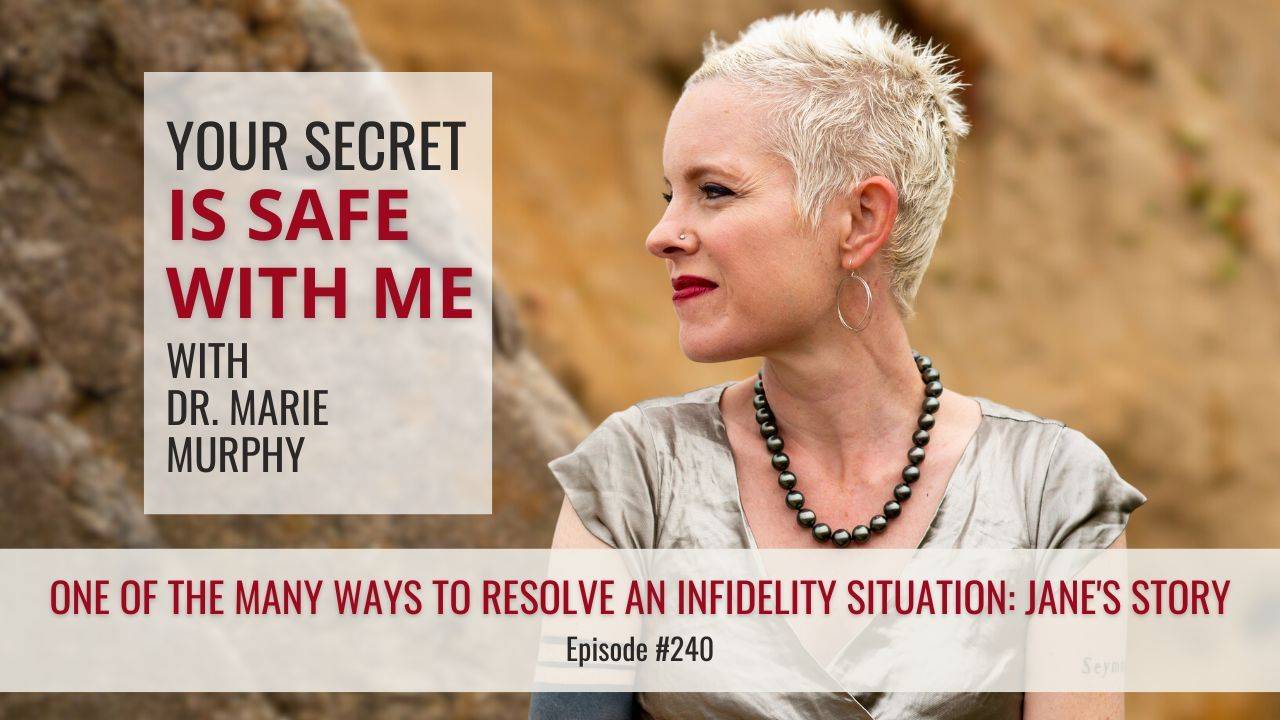
240: One of the Many Ways to Resolve an Infidelity Situation: Jane's Story
Aug 12, 2026What if an infidelity situation didn’t have to mean the end of your life as you know it?
In this episode, I’m talking with Jane, a woman in her late 60s who found herself having an affair after more than 40 years of marriage. She never imagined herself as someone who would have an affair, and yet reconnecting with someone from her past brought excitement, intimacy, and a sense of being fully seen that she had been missing.
Jane shares what happened when she decided she could no longer continue living in her marriage, how she navigated the decision to separate, and what happened to her relationship with her husband afterward.
She also talks honestly about the challenges of being in a long-distance affair, learning to tolerate uncertainty, and setting boundaries around communication so that her infidelity relationship could be part of her life without becoming her entire life.
Jane’s story doesn't offer a neat or predictable ending. Instead, it shows what can happen when we’re willing to take a risk, make decisions without knowing exactly how everything will turn out, and allow our lives and relationships to evolve.
Are you ready to resolve your infidelity situation in a way that’s truly right for you? If so, let’s get to work. There are two ways you can have me as your coach:
- You can enroll in You’re Not the Only One, my self-guided, online course that gives you the teachings and tools you need to resolve your infidelity situation in a way that you feel great about.
- If you want my personalized attention and support, we can work together one-on-one via Zoom.
Why wait any longer to find relief and a clear path forward? The rest of your life – beyond the drama and difficulties of your infidelity situation – is waiting for you!!
What You’ll Learn from this Episode:
- Why Jane never expected to have an affair and what happened when she reconnected with someone from her past.
- How an affair helped Jane recognize what she had been missing in her marriage.
- What ultimately gave Jane the courage to leave a decades-long marriage.
- How she and her husband created a close relationship after deciding to separate.
- Why you can make a decision even when you still have fear, doubt, and mixed feelings.
- How Jane learned to tolerate uncertainty about the future of her affair.
- Why setting boundaries within an affair relationship can actually make the relationship better.
- How Jane has maintained her own interests, friendships, and life alongside an intense romantic relationship.
- What it can look like to choose a more fully alive life without knowing exactly where that choice will lead.
Listen to the Full Episode:
Episodes Related to Resolving an Infidelity Situation:
- 96: When You Leave Your Marriage but Your Affair Partner Doesn’t
- 195: Affair Relationships Can Last a Lifetime
- 224: Going All-In On Your Desires
Featured on the Show:
-
Check out my brand-new YouTube channel!
-
If you want to submit a question for me to try and answer on the podcast, click here or email [email protected].
- If you have benefitted from this podcast, I would greatly appreciate it if you would rate and review the podcast, or send me a blurb about how it has been helpful to you. Click here to rate and review, or send your comments to [email protected]. Don’t forget to add your initials – real or fake!
Are you ready to resolve your infidelity situation in a way that you feel great about? There are two ways we can work together:
- You can purchase the DIY version of my program, You’re Not the Only One
- We can work together one-on-one
Resolving your infidelity situation may take some effort. And it is also totally do-able. Why stay stuck for any longer? Let’s find you some relief and a clear path forward, starting today.

Hi everyone. I'm Dr. Marie Murphy and I'm a non-judgmental infidelity coach. If you are cheating on your partner or having an affair, or you're the so-called other person, or you're engaging in anything you think counts as infidelity, I can help you deal with your feelings, clarify what you want, and make decisions about what you're going to do. No shame, no blame, no judgments.
Infidelity situations can present us with many novel challenges. And although you may be an extraordinarily capable human being in many respects, you just might want my expert guidance to help navigate your infidelity situation in a way that you feel great about.
When you're ready for my radically compassionate coaching, there are two ways we can work together. You can enroll in my online course, You're Not the Only One, or we can work together one-on-one via Zoom. To get started with either of these options, go to my website, mariemurphyphd.com.
Today, I am thrilled to share another conversation with a long-time podcast listener who goes by Jane. I enjoy this conversation with Jane immensely for a great many reasons, and I don't want to give too much away, but I will say this: Jane's story is a terrific illustration of the fact that there are many ways to "resolve" an infidelity situation. There is more than one way to skin a cat. And what that could mean for you personally is that there might be a way for you to deal with your infidelity situation that you feel really good about that is not something you have envisioned yet.
Another thing that my conversation with Jane touches upon is the need to set limits on texting with your affair partner!!! I'm going to have to do an entire episode on that soon, but for now, I hope you enjoy listening to this episode as much as I enjoyed recording it.
—
Marie Murphy: Hi, Jane. Thank you so much for joining me on the podcast today.
Jane: Thank you, Marie. It's an honor to be here.
Marie Murphy: Tell me how you found this podcast. You told me just a couple of minutes ago when we were chatting before the recording, but I want you to say it for all the listeners to hear, too.
Jane: Sure. In the beginning of my affair, I started searching the internet for some validation, trying to find out, am I the worst person in the world? I hope not. Has anyone else experienced this? I hope so. Am I doing the worst thing ever? And I mostly found stories and therapists about how the affair comes crashing down to a terrible end, and then either the marriage is over or there's all this painful repair work that's done in the marriage. That's all I could find. That wasn't suiting me. It wasn't helping me. And then I found you, and that was a relief, for sure. And I listened to a number of your podcast episodes, and I found that really helpful. And I felt a little bit less lonely and a little bit less of a terrible person.
Marie Murphy: I'm so glad. And that's the reason why I'm having you and some other guests on the show to talk about your experiences with infidelity so other folks out there can feel a little bit less lonely, a little bit less like their experiences are completely unique or completely wrong. So thank you so much for being here.
Jane: Thank you.
Marie Murphy: All right, without further ado, let's get into it. Tell me about your relationship situation prior to the commencement of your infidelity situation.
Jane: Sure. I was, until about 10 months ago, in a very long-term marriage that had no infidelity. We've been married for 41 years now. It was in many ways a very good marriage, although I often felt that something was missing, largely in terms of our intimate connection and also in terms of being seen for who I felt I fully am.
My husband also, it turned out, I found out 10 years ago, has a compulsive disorder that he's in recovery for, and I can see now how that really took a toll on our marriage over many, many years. So there were a number of factors at play, but we basically were happy, led a very, very normal, if you will, life, jobs, a kid. It was mostly good.
Marie Murphy: Okay. And then what happened? Did the marriage end or did the infidelity situation begin? I think it's the latter, not the former, but tell me what happened.
Jane: It is the latter. And the timing was interesting, Marie, because I had recently stopped working, and so I think I just had more bandwidth, if you will, to think about things. And I was feeling, maybe it was after the infidelity started. So the way it started was that this person reached out to me out of the blue over something very innocuous, and we had a brief relationship in graduate school over 40 years ago. And in our email communication, there was pretty quickly some really fun energy, and we found a lot of commonality in things that we're interested in and how we live our life.
Marie Murphy: What was that like to reconnect with this person after all these years? What was this experience like for you?
Jane: It was interesting. It was pretty quickly very energizing and kind of exciting, although I, it was the furthest thing from my mind that this would result in an affair. Although pretty early on, I did think, what is happening here?
Marie Murphy: This is a little extraordinary.
Jane: What is this? What is happening? And I think that it was, I know that it was very much the same for this person that I'm involved with, who I'll name Carl. It might be easier. So also in a very long-term, very traditional marriage. He was happily married. I had complaints. I think he was happily married. So this was also very baffling to him as well.
So we communicated. It got kind of more and more charged by email. Pretty early on, I said, maybe we should like Zoom or FaceTime, mostly because I was thinking, what is, what is this? And we did, and it was kind of awkward. And then maybe three months into it, we had a Zoom late in the evening over some bourbon. And then sparks were really flying, and I still was completely perplexed. And I think he was as well and still not thinking at all that this was going to lead to an affair because that's not, honestly, Marie, if that, I think we all think about this concept. We read about it, see it in the movies, and I always thought, that is never something I want to do. That looks very complicated.
Marie Murphy: Right.
Jane: Not just that it's wrong, just that it just is very messy. I don't want to do that. So that's how it started.
Marie Murphy: Okay. So how did you get from, you know, even over bourbon and Zoom to not really thinking that anything was going on? How did you get from that to being involved?
Jane: We live pretty far apart from each other, and I'm in Boston. He came to Boston for work. We met up at a hotel. We had dinner that night. We spent the next day together, daytime, and had dinner that night. And there was clearly still a lot of energy. And actually, he said that he wanted to kiss me, and I said, I don't think so. That's not what I do.
Marie Murphy: I love it. Yeah, that's not what I do. I hear this, you know, all the time. People are like, I'm not a person who would have an affair. But what I'm delighting in your story is just how long you held out for here, so to speak. Like, this isn't what's happening. That's not what I do.
Jane: So the few friends I confided in could hear this excitement in my voice.
Marie Murphy: Yeah.
Jane: And one of my friends, after Carl had left Boston, one of my friends really encouraged me to sort of pursue him, if you will.
Marie Murphy: Yeah.
Jane: And I did.
Marie Murphy: So how did that kind of gear turn in your mind or how did that switch flip from like, I don't do this to like, "Oh, good idea"?
Jane: I think it was that a friend like validating what she was hearing in my voice.
Marie Murphy: Okay.
Jane: And really encouraging me, honestly.
Marie Murphy: Yeah.
Jane: I don't know. I don't know, I think it would have taken longer without that.
Marie Murphy: Yeah, that's really interesting. And what were you thinking about your spouse as all of this was unfolding with Carl?
Jane: I was thinking, that's an interesting question. I had told my spouse when I started communicating with Carl that I was communicating with someone I had a relationship with a long, long time ago. And he never asked any follow up questions, ever.
Marie Murphy: What did you think about that?
Jane: Oh, it was interesting. I kept communicating and what I thought was, I don't want my husband to know the nature and frequency of this communication. That wouldn't be good. That's the extent of what I thought.
Marie Murphy: Sure.
Jane: At that point.
Marie Murphy: Okay. So how did things start to develop from there, both with Carl and with your husband?
Jane: So with Carl, we had a Zoom after we'd seen each other, and I said I tried to take the moral high road. And it's not working for me. And I said, every fiber in my body wants to go to bed with you. And he, he sort of gestured that it was the same for him. So when I said that, when I had that conversation with Carl, he made a plan to come back to Boston about three weeks later.
Marie Murphy: And did you survive? I mean, obviously you survived waiting those three weeks. We're talking now.
Jane: Definitely. It was fine. It was totally fine. I just went on with my life. And we continued to communicate a lot.
Marie Murphy: Sure. But okay, so there's a really powerful lesson in this, right? We can wait for things that we're looking forward to without exploding. We can go about our lives anticipating something that we're really looking forward to without being totally driven to distraction.
Jane: Yes, we can. Absolutely. I continued to live my life, meet my responsibilities, do things with my husband.
Marie Murphy: Yeah. Okay. So you're in Boston together. This time, what happens?
Jane: Well, this time we were in a hotel room, so.
Marie Murphy: So hotel room things happened.
Jane: Yes. Hotel room things happened and dinner and more hotel room things and dinner and yeah. And then we were in it.
Marie Murphy: What was this like?
Jane: It was, it, you know, it just felt so natural.
Marie Murphy: Yeah.
Jane: And like sort of inevitable and right, although it's wrong.
Marie Murphy: Yeah. What had the nature of your relationship been back in grad school? Was it pretty intense? Was it kind of casual, somewhere between?
Jane: It was a brief romantic relationship that just didn't evolve. I think we weren't ready and it just petered out, if you will.
Marie Murphy: Yeah.
Jane: Although now it feels like there was some unfinished business perhaps.
Marie Murphy: Yeah, yeah. I mean, you know, sometimes we reconnect with someone and it's we've been kind of like low-grade yearning for them the whole time that we've been apart. And sometimes it's just like, "Oh, there you are again. Oh, this is something interesting in a way that I could never have imagined it could be."
Jane: And it's the latter for both of us. Yeah, yeah.
Marie Murphy: So you're in it. And?
Jane: So we're in it. Because we live far apart, which I think actually creates a certain level of safety and even discipline, if you will.
Marie Murphy: Yep, yep. Say more about what you mean by that. I can imagine what you mean, but I want you to articulate it in your way.
Jane: I think if we were in the same city that we would be taking greater risks and there'd be more frequent contact and I think there'd be, I think it would be more absorbing, if you will, a little harder maybe to keep up, speaking for myself, to keep up with my life. And I think there would be a higher risk for discovery, which we are, you know, trying to…
Marie Murphy: yYou don't want.
Jane: We don't want, yeah.
Marie Murphy: Right. Right. Yeah. Yeah. I mean, I, I completely understand what you mean. There's this natural geographical separation, which can make for an ease of, well, for some people anyway, such as yourself, it sounds like. It can make it easier to be less obsessed, less consumed, less fixated. Now, it doesn't necessarily work that way for everyone, as I can tell you. But what I want to suggest to people who are listening is that like Jane, you can leverage geographical separation as a means of managing the amount of space your affair takes up in your life if you want to do that. And you might want to do that.
Jane: Yeah, and that, even with the distance, that is something that I've had to, that we've had to work at because the draw is very strong, and I feel that I really need to maintain my interests, my life for my, even for my own safety, if you will. It's hard to know, honestly, Marie, even in a traditional marriage, I think we need to have a life outside of the marriage for so many reasons. So there has been a level of very intense, frequent communication that we worked on reducing.
Marie Murphy: I want to talk more about that because it's such an important topic. But keep telling the story. Like, how did things evolve with Carl? What happened with your husband, etc.?
Jane: So at first, I was happier. And that was good for the marriage.
Marie Murphy: Yeah, yeah. That's a thing.
Jane: And I certainly, of course, still knew it was wrong and that my husband would be devastated, but I was happier. Until I wasn't happier anymore in the marriage. And that took about, well, maybe a year and a half, a year, something like that. And I think it was a, well, I know that it was a combination of being unable to live with the deceit. There was a lot of deceit, a lot of made-up things that does not comport with who I am.
And also, you know, the fact that my husband was so clueless that there'd been a change. I was careful not to wear, well, some jewelry that Carl gave me, and then I started wearing it. My husband didn't even notice. And so I think that some of the dissatisfaction that I'd had for a long time with the marriage became intolerable, plus the deceit became intolerable.
And I had, I thought about it for a long time. I journaled about it for a year about separating. I looked at our finances. I didn't want to devastate us. I looked at other places to live. I didn't want to devastate myself. So I did some homework and some journaling. I talked about it in therapy. I talked about it a little bit with friends. And then I let it be. And it turned out a year later, I went back to journaling about it. I was more unhappy. And I found what I'd said a year prior and it was the same words.
Marie Murphy: Yeah. Yeah.
Jane: And I lived with it some more, and then I just one afternoon had a rupture that was quite surprising to my husband, although he said, "I sensed you were unhappy."
Marie Murphy: Okay. So what did you say to him more or less when you had your rupture?
Jane: It was very inelegant. It was very unplanned. I said, "I can't do this anymore." And he didn't know what I was talking about at first, and then he quickly grasped, and he asked the questions. Are you saying you want to separate? And he asked, is there someone else?
Marie Murphy: And what did you say?
Jane: I said, yes.
Marie Murphy: Okay. And what did he say to that?
Jane: I think that, well, he had a lot to say for a few weeks, and it could have been worse. I mostly just let him share his opinions about it. I didn't, and I think this served us well, I didn't argue. I didn't, I just said, "Okay, all right, that's what you, okay, all right, that's what you think, you know?" And then we went back to kind of this peaceful cohabitation, and I realized that I just needed, I needed to leave. And I had an opportunity to sort of live with, in a friend's house who had an apartment that she couldn't rent for various reasons, and I moved out. And we started, probably before I moved out, some couples counseling. Not to come back together, but to navigate what was happening.
Marie Murphy: Yeah. And how's that been for you?
Jane: We finished. We did it for, I forget, two months, maybe, and it was really helpful.
Marie Murphy: Great.
Jane: And it was somebody who knew us and knew some things about our story and was able to work with each of us, and it was really, really helpful.
Marie Murphy: What do you think you did, you and your husband did to make those couples counseling sessions so helpful?
Jane: We had done a lot of work on our relationship, I think we were really both invested in not doing a lot of damage. And we've stayed that way. We're communicating well. We get together.
Marie Murphy: That's awesome.
Jane: It's really good. It's probably better than it was.
Marie Murphy: Oh, so good.
Jane: It's like more comfortable.
Marie Murphy: Yeah, yeah. Oh, I can imagine. I just want to go back to one thing, and then let's talk about your current state of relationship with your husband. Did you go to couples counseling with a clear agenda for what the two of you wanted to work on?
Jane: Not exactly. My individual therapist had suggested it, and he, my husband said, "I don't want to do that if we're not working towards reconciliation." And I asked if he'd be okay if I saw her because I just had this intuition it would be helpful, and he said yes. And then he changed his mind that he would be, wanted to see her together because I think he saw we could use some support in why this was happening, what was happening, and how to navigate it.
Marie Murphy: Amazing. Amazing. What do you think that made possible that wouldn't have otherwise been possible for the two of you?
Jane: I think all the work that we had done, couples work we had done, individual work we had done, some recovery work that we've done. I think that all made it possible. And I think we're evolved. We have a lot of tools. He has a lot of tools. He engaged them, those tools. And he, to his credit, was able to let go and also to sort of see through a different lens that his addiction, if you will, really took a toll on the marriage and that I really had stood by him through some really difficult times. And so he had an understanding of how this could come about. And I think that he had, in some ways, at different points, had expected me to leave, and I didn't.
Marie Murphy: Just say a little more about your relationship with him now and the relief and the - whatever is great about this next iteration of your relationship with your husband or ex-husband or whatever you call him these days.
Jane: Yeah, I don't call him my ex-husband.
Marie Murphy: Okay.
Jane: It just seems so, I just, I just don't use that. But it does seem very jarring. Did you say what is it like?
Marie Murphy: Yeah, what's it like? What's great about it?
Jane: You know, it's not all great. There is pain in, you know, kind of looking back and thinking, wow, there were a lot of good times and for me thinking, what the hell have I done to my life, you know? But for the most part, I feel I made the right decision, and what it's like is that we are supporting each other in some logistical ways and setting up our lives and two new apartments. There's some logistical things we need to talk about, but the apartment we share together here in Boston. And we go out to dinner. He comes over to my apartment, helps me hang some things, and we're not going to the movies or the theater or music or anything like that, but we stay in touch, and we get together.
Marie Murphy: Yeah.
Jane: And for our last anniversary, he said, "Happy first anniversary as friends."
Marie Murphy: Oh, what did you think about that?
Jane: I thought it was incredibly sweet.
Marie Murphy: Yeah.
Jane: Sometimes, you know, Marie, sometimes it's been confusing because he's so nice and I feel like I've done such a terrible thing and it makes me think, what's wrong with me? Why would I leave such a kind and nice person? You know, I think when there's conflict, anger, and sometimes that is a motivator, too. I don't wish that for myself or anyone. I'm so proud of us. We're also doing it for our daughter, you know, so to model something, and so I'm really, I think we're both really grateful. I talked to an old friend today who's been in touch with him and she said he's, you know, he says you're getting along, and it confuses people also. It's the other challenging thing is people are like, if you're getting along, why are you separated?
Marie Murphy: Yep.
Jane: My husband wanted us to say it was mutual, not saying anything about my other relationship. He doesn't ask about it. I don't talk about it.
Marie Murphy: I want to thank you for sharing this because I work with so many people who do not believe that it is possible to have a post-infidelity relationship with their spouse or former spouse or quasi-former spouse or whatever that person becomes to them. And you are illustrating something that I see in the privacy of the coach-client relationship and in my own personal relationships, but isn't nearly visible enough in my opinion, and that is that it is possible to have a relationship like the one you're describing with your spouse, even if you've had an affair or they've had an affair and you've decided to separate, you can still remain close in some ways. You can redraw your connection in ways that may be confusing but can also be wonderful. And when you said that, you know, "Happy first anniversary as friends" thing, I mean, my heart swelled. To be able to evolve like that with someone. What a gift.
Jane: Yeah, it really is. And, you know, I have to say that I didn't know. I wasn't even thinking about what would happen when I had this rupture. It might not have gone this way. There is a risk, I think. We don't know.
Marie Murphy: We never do. We never know. And, you know, sometimes, as you've been telling me the story, like I've been thinking about it a little, and, you know, sometimes the best thing we can do is just jump off the diving board and try to swim, you know, and I'm not saying that's the only way to do it. Of course, I work with people to plan their breakups or plan their ruptures, so to speak, and planning can be useful, too. But sometimes you just got to spit it out. And if you find, what I love about your story is that it illustrates that you can just spit it out and figure it out as you go, and that can lead to beautiful places.
Jane: Yeah. Now, for me, it's maybe a bit of a non-sequitur, but what happened for me, and I'm sure you've heard this story, this sort of story before, is that the affair showed me what I was missing. And what I was missing, it was hard for me to really feel sure this is what I was missing in my marriage. It was very hard for me to feel sure that I could find it, that I deserved it, you know, those sorts of things when I'm in a very stable relationship with someone who supports me, is kind to me, is a good father, is blah, right? Then when I entered into this affair relationship, I was like, oh my god. And now I said to myself, I can't go back. Whatever happens with the affair, I can't go back because I've, now I know.
Marie Murphy: Right. Say a little bit about what was so good within the affair that you knew you couldn't go back.
Jane: Being seen fully for who I am, someone being really deeply interested in what I do and what I did and what I do on a daily basis, someone who is expressing how interesting I am and how amazing I am, someone who's telling me I'm beautiful, and the attraction was very, very strong, so the intimacy was very, very fulfilling.
Marie Murphy: Yeah, yeah. Yeah, absolutely. And I mean, I find so often that people have a really hard time weighing those kinds of experiences against a stable, good enough, happy in some respects, family life that comes with a marriage that they aren't especially fulfilled in. And so I just want to know what you think at this stage about being willing to go for it and to say, "I want this in my life. I want this relationship that I have with Carl. I want to enjoy this."
Jane: And your question is, repeat your question.
Marie Murphy: Yeah, sorry.
Jane: I got the end of it.
Marie Murphy: I think I kind of lost my question, too. What I'm asking is like, what do you think allowed you to go for it? You could have said, oh my God, you know, like, I'm not a person who does this kind of thing, like, no more affair, let's forget about that and just be married.
Jane: What allowed me to go for it is that I saw and felt like I was shrinking to accommodate the marriage and my husband, and that maybe I had been doing that for a long time, like being the good girl, doing the right things in every - in work, in every aspect of my life, never really straying, growing but not straying. And I think finding you and reading about gray divorce and seeing like, there, wow, there are a lot of women, it seems, who, we haven't talked about my age, but maybe listeners have figured it out, I'm in my late 60s.
There are women who in their late 60s are saying, wait, I have one more big phase or stage, and I don't want it to be this. I want to take the risk, and I felt like I wasn't flourishing or blossoming, and I didn't really know what that would look like or what that meant or am I going to find a new passion, a new career? I didn't know. I just felt like I can't do this anymore. And I just had the support and the courage, I guess, to take the leap and have faith.
Marie Murphy: I love that. And to those of you listening, I can see Jane right now, even though you can't, and she's this radiant creature. Before we even said anything, it was just clear that there's this being in front of me on the screen who is alive and is delighting in her aliveness. That really comes across.
Jane: Oh, thank you. Yes. Yes. I feel not only more alive, I for the most part feel less anxious, which has been very interesting. I've been sleeping better. Don't get me wrong, I have moments of some loneliness or some fear or things aren't quite perfect and again, I said it earlier, what have I done? But honestly, you know, once I did it, I couldn't undo what I had done. And so when I was struggling, I also said, well, I'm already in it. I've already done it. I'm going to just have to keep going forward.
Marie Murphy: Yes.
Jane: Also, I was completely unwilling to end the affair. And so that and that what, we never talked about like an open marriage or anything. It just couldn't. So that also kept me going on a path that is, you know, sometimes is scary, sure.
Marie Murphy: Sure. Yeah. Yeah. I mean, it really strikes me how decisive you've been, or at least it sounds like you've been throughout all of this. And I like that you're emphasizing that there has been fear, there has been doubt, there has been anxiety. And what I think, and I work with people on this in great detail, but what a lot of people don't understand is that even when we're being decisive, even when we know what we want, even when we're as confident as we can be that we're doing the best thing for us, yeah, there are still going to be mixed feelings.
And that's okay. And to your point, often it's better to just keep going than to say, "Oh, this is uncomfortable. I better turn around and crawl back into my hidey hole." I mean, not that, I'm not saying that we can't change our minds. We can. Sometimes that happens. Sometimes that's great. But when the going gets tough, that's not automatically a signal to abort the mission.
Jane: Yes, yes.
Marie Murphy: Yes.
Jane: I also am able to live with uncertainty in this situation, to live with not knowing where is this affair going?
Marie Murphy: Okay, so hang on. This brings us to a very important bit of detail that we haven't yet covered. So what's going on with Carl, and what's going on with Carl's marriage?
Jane: So Carl feels, believes that there would be extensive devastation if he were to leave, for his wife, obviously, for his adult kids, for his family of origin, for his friends, for his whole world.
Marie Murphy: I hear that about once a day.
Jane: And from what I can see, I think that's true.
Marie Murphy: Okay.
Jane: And I don't want that for anybody.
Marie Murphy: Sure.
Jane: Yeah. And I also don't want to be with somebody who has lost everything.
Marie Murphy: Yeah.
Jane: Thus far, we navigate that.
Marie Murphy: So let's just be clear for everybody who's listening. So the decision, it sounds like on your part as a couple is to continue the affair as an affair without there being any plan on Carl's part for him to leave his marriage. And that's the agreement that you share. Is that about right? Tell me more.
Jane: That is correct. That's correct. And I encourage nurturing of that relationship.
Marie Murphy: Yeah. Yeah.
Jane: Because I don't want to lose him, and I don't want him to be devastated. I just came off of a decades-long marriage. I'm not really eager to just start building a life with somebody.
Marie Murphy: Yeah.
Jane: So I don't know what's going to happen down the road, right? I don't know if in six months, a year, two years, I'm going to say, "I don't want this. This is not what I want."
Marie Murphy: Mmm hmm.
Jane: But that's not where I am now. I don't know if he's going to say, "I can't do this anymore." I don't know if he's going to say, "Actually, now I'm ready to leave my marriage." I don't know what's going to happen. And I can live with that.
Marie Murphy: I love it. I love it so much, and I'll tell you why. First of all, none of us know what's going to happen. I think I know what I'm doing for the rest of this day. We need to think we know what we're doing in our days, otherwise we'd never get anything done. But I could walk out of the house and an alien could come and abduct me or, you know, like, I don't know, ICE could come along and decide that I look suspicious or something, right? I mean, these things are happening. I don't know about the aliens part, but anyway, I mean, I shouldn't get into this. I really shouldn't. But the point is, weird shit happens. We don't know what's going to happen. That's more true than thinking that we know what's going to happen.
And being able to tolerate that uncertainty is a skill that we can all build. It sounds like you're just kind of naturally disposed to be able to do that, or maybe you've worked on it a lot, I don't know. But either way, we all have this capacity to deal with uncertainty in a manner that it doesn't level us, even if it is uncomfortable at times to contend with the fact that life is inherently uncertain.
But let's talk about something that's a little bit more, I don't know if concrete is the right word. You're choosing to stay in an affair situation. How do I want to say this? There are things about that, I would imagine, are uncomfortable for you or are challenging for you, such as perhaps limits on his time and availability. If that's the case, why do you choose to deal with that stuff?
Jane: He actually gives me a tremendous amount of time, not quite enough in-person time, but a tremendous amount of, I mean, you know, a month, two months could go by where we're not physically together. But yes, as our intimacy deepens, sometimes it, let me put it a different way. As our intimacy deepens, it becomes harder for me to sort of deal with that he's got this whole intimate life. By intimate, I just mean close.
Marie Murphy: Yeah.
Jane: Family.
Marie Murphy: With someone else, yeah.
Jane: And so the way I've chosen to navigate that, in addition to saying, articulating that to him, is to say, "I no longer want to tell you." It's not a punishment, so I didn't say no longer. I cannot continue to tell you everything I'm doing every day, and I don't want to know everything you're doing every day. I need some separation, and I can't really tolerate hearing all the wonderful things that you do with your wife. And so we really, we're able to be very honest about the difficulties and the challenges, and that ability just kind of brings us closer, if you will.
Marie Murphy: Yeah.
Jane: The last time we were together, just to tag off of something you were just talking about, we made an emergency preparedness plan because this is something that's very scary in an affair.
Marie Murphy: Yep.
Jane: And if you, if your affairs take all sorts of different, they're, yes, a spectrum. I get it. We're very in love. We are very in love. So it's very scary. And he had said to me recently when we didn't have contact for a day and a half or something, that he thought I had died. And I said, "We need a plan. You need somebody you can call and ask…
Marie Murphy: Jane, where's Jane? Yeah.
Jane: And so we worked on that last time we were together.
Marie Murphy: Good for you. Good for you. Yeah, I think this, you've, you've raised two points that I think are really important, and I'm just going to go back to the previous one for a minute. I see affair couples getting into such unnecessary suffering when they share all of the details of their day-to-day. And this is true for affair couples who have all kinds of different situations, if they're both married, if one is and one isn't, and there are all sorts of different other combinations, too. If you are not able to have parity in your relationship in terms of your relationship status or other things, too, I highly encourage people to not overshare and to have some agreement about like, these are the things that it's important for us to disclose to each other, like I'm going on vacation with my family for five days. That's what's happening. But you don't have to share every damn thing that happens every day.
Your affair partner doesn't necessarily want to know that you had a great conversation with your spouse, even if you love your affair partner more, they still don't necessarily want to hear about that. And it seems unsexy to some people to set these kinds of limits, but to your point, it can be so much sexier to set these kinds of limits and just not have your mental and emotional energy drained by things that just aren't helpful, that don't get you anything. So that's one thing. Bravo to both of you for figuring that out.
But the other point that you just raised, which is so important is, especially if you're in a very caring, committed, loving, long-term affair situation, you probably want to have a way to deal with emergency situations. You want to have somebody you can call. You want to be able to check and see if the other person's okay. If you're a married person and your spouse finds out and they take your phone and do all the things, how are you going to let your affair partner know what's happened, right? And there are, you know, endless other things that could be like added to the list of possible scenarios to plan for. But this is really important stuff to think about.
Jane: And technology, I read, you know, I referenced early in our conversation, searching the internet, you know, technology, what I read on the internet is technology is often what dooms an affair.
Marie Murphy: Yes, it can be a problem.
Jane: There are precautions that you can take. Like we don't text. We're on WhatsApp. It's a little bit more hidden than, we delete emails. I mean, there's lots of things that we're doing because, you know, and again, that makes me feel like I'm a terrible person because I'm hiding things. But actually, we're just trying not to hurt anybody. We're just trying not to hurt anybody.
Marie Murphy: Yeah. I mean, it's a difficult needle to thread. I mean, it's funny, like, myself, I have cheated and I've been cheated on, and, you know, if I were, and obviously, I'm speculating way beyond my data here, but if I were Carl's wife, what would I prefer? Do I want a spouse who comes home to me and maintains the family and everything's fine and there's something that I don't know about, or would I rather know the truth or a truth, so to speak, and have my nice little illusion shattered? Who knows? Who knows what's better? In the personal scheme of things and in the cosmic scheme of things.
Another thing you mentioned that I really want to highlight is, you know, you said, I don't know what I'm going to want in the future. Maybe I'll get to a point where I don't want to do this. Maybe things will change on Carl's end and that will change things for me. You know, and I think it's so valuable to be able to give ourselves to love in the present, even though we don't know for sure what we're going to want in a month or a year or 10 years or whatever.
Jane: Yes. I mean, it's so different than when I met my husband in my early 20s, and I knew. I had already been in a long-term relationship. So I knew, and this is going to sound terrible, but I never want to operate like this again. I knew, I only wanted to live together for six months before we had a plan to get married. I knew I wanted to have a child. I knew I wanted, which is, that's okay, too. Like I knew all those things, and if he couldn't deliver on those things, I was going to move on.
But now I'm in a totally different stage of my life. I've done that. As we talked about, lots of great things there, lots of not-so-good things, but I've done that. I don't need that certainty. I don't need to be, just speaking for myself, obviously. I don't need to be building a life with someone else, even though, in essence, Marie, that is what's happening. I am building a life with someone else.
Marie Murphy: Right. Right.
Jane: I mean, let's be honest. I am.
Marie Murphy: Yeah. And I mean, tell us about what's great about that and also tell us about what's difficult about that for you.
Jane: Well, what's great about it is that whenever we're together, we have fun. We have these conversations about navigating what we're doing. We love eating out together. We, without getting into too much detail, we spend a lot of time in bed, and that's incredible.
Marie Murphy: Yeah.
Jane: You know, we're growing together in many ways. So all of that is, and then that means we're growing as individuals, too. I mean, we each are growing and learning things about ourselves that we didn't know before. And what's difficult is it's difficult when in-person time together comes to an end. That transition is very painful.
Marie Murphy: Yeah.
Jane: We know it takes a day or two and that then we're back in our individual lives and we survive, and we know we'll see each other again at some point. So I think that's what is, that's what's most difficult.
Marie Murphy: Have you found any particular, I don't know what the right word might be, but tools or techniques or practices that help you ease that transition away from him and back into daily life?
Jane: Not really. You know, I mean, I think I learned recently it's better for me not to be alone. You know, I should have some plans. It's hard because part of me wants to call up some friends and cry, but part of me feels like, aren't those friends at some point going to say, "Well, what were you expecting, Jane? Right?" So I feel like I can't really do that till I'm a little more stable, if you will, and then I can talk about the time together and that it was sorry, you know. So I think it's something I need to work on. I tend to come home and do laundry, catch up on email, catch up on life, and which also feels good so I can get back into a routine. But I need to get out into the world more when our in-person time comes to an end.
Marie Murphy: I mean, this is not a judgmental statement, but just for your own frame of reference, it sounds like you do a better job of dealing with that transition than some people do. Some people, I mean, and bless their hearts, you know, it's a hard thing, but some people are just kind of like mush after they see their affair partner, and getting back into daily life is like, how am I going to do this? And, you know, to your point, like just getting the laundry done can be remarkably helpful. And maybe there are opportunities to refine your strategy in ways that serve you.
Jane: Well, as I said to Carl after we were together last time, "I'm really struggling, but I am not in a pile of, a puddle of tears, and I'm not day drinking." Not that I day drink, but you know, because I want to be honest that I'm struggling, but I also, I don't want to make him suffer more, in a way, because he's suffering, too. So you know, I don't need to do that. Like, I will get through this. I am going to be okay. I mean, there's no, I don't see any value in expressing, you know, endless pain after we're together every time because when we're together, it's wonderful, and we'll have that again, and that's, I can hold out for that.
Again, why it's so important, was so important to me to reset our relationship and have a little less communication, a little less of everything I'm doing. And also, I really wanted to make sure that I don't get sucked into the amazingness of this at the expense of pursuing other interests. You know, I went to my book club and I hadn't finished the book and everyone else had. Like I want to have time to read that book, right, or so that I can stay in these other communities.
Marie Murphy: Right. You're hitting on something that I think a lot of people have trouble with, and that is figuring out how to navigate the difficulty of not being around your affair partner, especially after you've just seen them, without overburdening your affair partner with the pain of not being in their presence anymore. What I see a lot of folks doing, and again, this is not a judgment, but it is an important contrast, what I see a lot of people doing is sharing, perhaps we should say oversharing with their affair partner how terrible it feels to not be around them anymore.
And to folks who are listening, if you're doing this, it's not a terrible thing that you've been doing this, but what I want you to ask yourself is, what are you getting out of doing that? And do you like what you're getting out of doing that? And it may be that you just feel like you've got this person who you're closer to than anyone else in the world, and you just want to share everything with them. But is that getting you more of what you want out of your relationship? And my guess is probably not.
And so what I think, Jane, you're presenting a beautiful example of is even if it's hard to set some boundaries in the affair relationship, even if it's hard to create balance in your life so that you're not just focused on your affair, no matter how wonderful it is, it's worth the effort.
Jane: Yes. And that was very hard for me, Marie. It was very hard for me. I was the one who set boundaries. It was there, it took me a long time. And it's only fairly recent. And it was like a, it was like a week of drug withdrawal.
Marie Murphy: Yeah, for real.
Jane: I mean, really, it was, and it was scary for both of us. But we got through the week, and we were able to, I was much more able then to say no or to end a long conversation or to, you know, and it, it feels better. I feel more sane.
Marie Murphy: I love it. Can you give us just like perhaps one example of a limit that you set or a practice that you changed with Carl?
Jane: One thing is I will not tell him everything that I'm doing.
Marie Murphy: Right.
Jane: I mean, we were talking recently, I was leaving a bookstore and I said, "I'm not telling you the book I bought." And he thought that was hilarious. He's like, "You're not telling me a book?" It was actually a pretty personal book. I'm like, "I'm not telling you the book I bought." And he said, "It's private?" I'm like, "Yes."
Marie Murphy: Yeah.
Jane: Anyway, there's that. And then I would guess this is not uncommon. I'm almost ashamed to admit that there were days where we would communicate, well, four hours a day between email, text, phone. I can't keep doing that. So I just, I have to be the one to be disciplined about it.
Marie Murphy: Yeah, because he won't, he'd talk to you all day if you were available. Yeah. Sure.
Jane: And there were times where there were, we'd be having a conversation, and after maybe 45 minutes, I really was ready to get off the phone or something else. And I couldn't do it. And now I can do it.
Marie Murphy: This is really profound. This is stuff that a lot of people struggle with. How did Carl respond when you were like, "Okay, guess what? New regime"? What was his response?
Jane: I think he was really scared. Yeah, I think he was scared. And I really believed it would be better for him, too.
Marie Murphy: Yeah.
Jane: And ultimately it was.
Marie Murphy: Yeah.
Jane: I mean, he said as much. But he was scared. It was hard. It was really hard. That's why it took me so long. And it's something I had brought up many times. And then it became very clear to me that I had to be the one to do it. And that was really hard. Really hard.
Marie Murphy: Yes, you've hit on something that's incredibly important and incredibly common, and that is one or even both members of an affair couple may know, like, okay, like we are communicating in total for, you know, more of the day than we're working, basically, or more of the day than we're sleeping, right? And this isn't really how I want to be living, but I don't want to be the one to set the limits. I think we should just talk about setting limits and come to some sort of mutual agreement about setting limits, and we both have to propose the same limit at exactly the same time, otherwise it's going to be terrible, right?
And often that does not happen. In fact, I've never heard of that happening. And one person usually has to be the one to be brave and to set the limits and enforce them, and it is scary for everybody, and what's on the other side of that can be great for everybody.
Jane: Yeah.
Marie Murphy: Thank you for being an example of what is possible there. Jane, it's been an absolute pleasure talking with you. Is there anything else you want to say about any aspect of your situation that you think it would be useful for other people to hear?
Jane: It has been one of the most life-affirming experiences that I've had.
Marie Murphy: Yeah.
Jane: It just really has. And I'm glad I went for it. I think that it - I'm not sure if I would have been able to leave my marriage without it. And some people write about an affair being a crowbar to get out of the marriage. I've even said that.
Marie Murphy: I've even said that. Crowbar, can opener, all those kinds of metaphors. I don't know.
Jane: I mean, it is what it is. This is what's happened. But it's been incredibly life-affirming, expansive, rewarding. I feel better about myself. I feel like I've found myself.
Marie Murphy: Amazing. Amazing. Thank you so much for sharing with us. I am beyond confident that lots of people are going to be really grateful to you for sharing your story. And I'm grateful to you for sharing your story. So thank you so much for being here today.
Jane: Thank you. It was wonderful.
—
All right, everyone. That is just about it for today. Another big thanks to Jane for being a guest on the show. As I've said in the last couple of episodes, so many of the stories we hear about people's experiences with infidelity emphasize how awful infidelity is and how it destroys people's lives and how if you've engaged in infidelity, you're doomed to be miserable forever. But even if those kinds of stories are true sometimes, or have elements of truth within them sometimes, they aren't the whole truth. They aren't everyone's truth.
So I'm really grateful to Jane and to my other recent guests for being willing to share their stories and help change the public conversation around infidelity. Thanks to all of you.
And if you want help dealing with your infidelity situation in a way that's truly right for you, let's get to work. You have so much to gain by starting to deal with your infidelity situation in a conscious, deliberate way sooner rather than later. There are two ways that you can have me as your coach. We can work together one-on-one via Zoom, or you can enroll in my online course, You're Not the Only One. Either way, we'll find you some relief and a clear path forward.
Thank you all so much for listening. I wish you a wonderful day. Bye for now.
Enjoy the Show?
-
Don’t miss an episode, follow the podcast on Apple Podcasts or Spotify.
Ready to talk?
Schedule your introductory coaching session with Marie.
Want the answers to your questions?
Sign up to get the free guide to the podcast, which shares the exact episodes you need to tune into to get started answering the questions you have about your infidelity situation.
We hate SPAM. We will never sell your information, for any reason.

Hi, I'm Marie!
I’ve helped hundreds of people successfully resolve their infidelity situations. I can help you resolve your infidelity situation in a way that’s truly right for you, too.