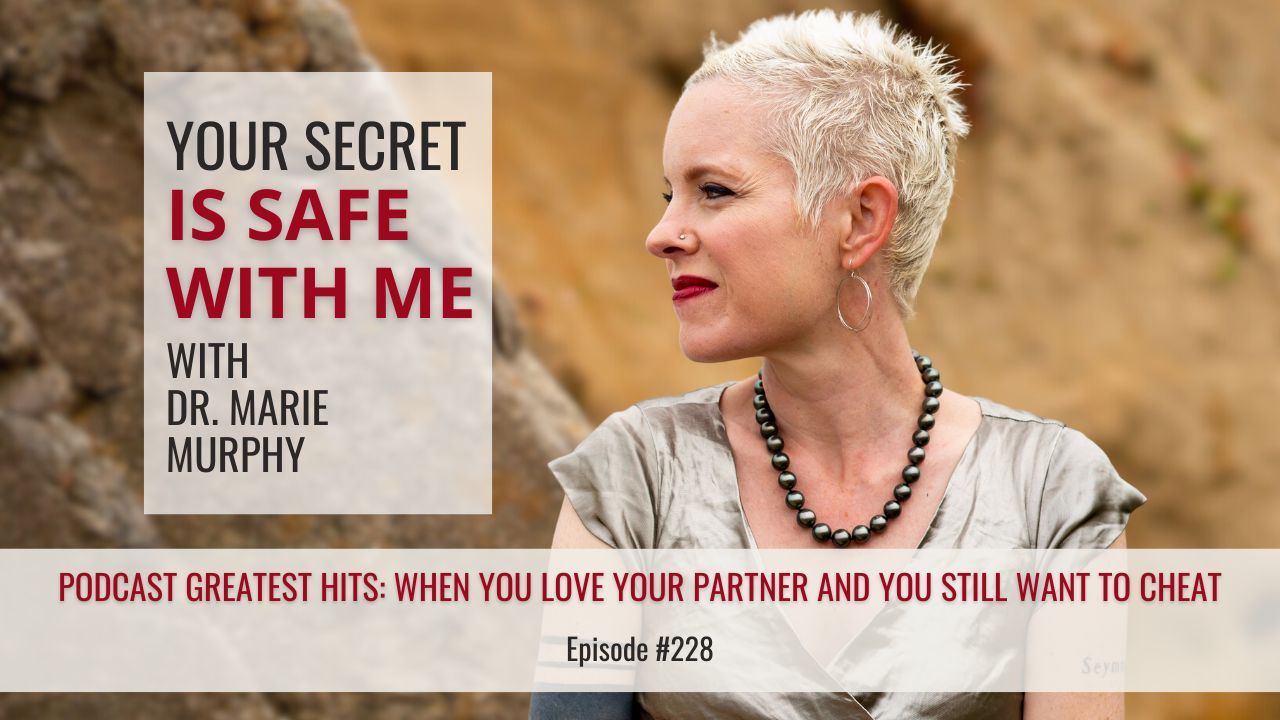
228: Podcast Greatest Hits: When You Love Your Partner and You Still Want to Cheat
Feb 25, 2026Is it possible to deeply love your partner and still want to have sex or romantic experiences with someone else?
If you’re in a committed relationship that was supposed to be monogamous, and you find yourself wanting more than that, you may feel confused, ashamed, or worried about what that says about you. You may wonder if something is wrong with you, your partner, or your relationship.
In this episode, we’ll explore the reality that desire for more than one person is not inherently a problem and does not automatically mean your relationship is broken.
Tune in this week as I unpack how our ideas about monogamy are shaped by social and historical forces, why wanting something outside the bounds of monogamy doesn’t make you defective, and why your first priority is figuring out what you actually want. You’ll also learn how to examine the reasons behind wanting to cheat or open your relationship, and how to think more consciously about the consequences you’re willing to tolerate.
Are you ready to resolve your infidelity situation in a way that’s truly right for you? If so, let’s get to work. There are two ways you can have me as your coach:
- You can enroll in You’re Not the Only One, my self-guided, online course that gives you the teachings and tools you need to resolve your infidelity situation in a way that you feel great about.
- If you want my personalized attention and support, we can work together one-on-one via Zoom.
Why wait any longer to find relief and a clear path forward? The rest of your life – beyond the drama and difficulties of your infidelity situation – is waiting for you!!
What You’ll Learn from this Episode:
-
Why loving your partner and wanting to cheat are not mutually exclusive experiences.
-
How definitions of cheating and open relationships vary widely.
-
Why monogamy is a social construct rather than a moral absolute.
-
The importance of clarifying what you want before talking to your partner.
-
Why examining your reasons for wanting to cheat or open your relationship matters.
-
How to think consciously about consequences and trade-offs.
Listen to the Full Episode:
Episodes Related to When You Love Your Partner and You Still Want to Cheat:
Featured on the Show:
-
Check out my brand-new YouTube channel!
-
If you want to submit a question for me to try and answer on the podcast, click here or email [email protected].
- If you have benefitted from this podcast, I would greatly appreciate it if you would rate and review the podcast, or send me a blurb about how it has been helpful to you. Click here to rate and review, or send your comments to [email protected]. Don’t forget to add your initials – real or fake!
Are you ready to resolve your infidelity situation in a way that you feel great about? There are two ways we can work together:
- You can purchase the DIY version of my program, You’re Not the Only One
- We can work together one-on-one
Resolving your infidelity situation may take some effort. And it is also totally do-able. Why stay stuck for any longer? Let’s find you some relief and a clear path forward, starting today.

Hi, everyone. I am Dr. Marie Murphy, and I'm a non-judgmental infidelity coach. Today, I am re-sharing one of the most popular episodes of this podcast, which was originally released a few years ago. It is called When You Love Your Partner and You Still Want to Cheat, and I hope you enjoy it, whether you've listened to it before or this is your first time hearing it.
Today, we are going to talk about the possibility that you may be in a monogamous relationship or a relationship that's supposed to be monogamous, and you may love your partner, and you may still want to cheat. Now, sometimes people come to me and say something pretty close to that. They'll say, "I'm married, or I'm in a committed relationship, and I love my partner, and I want to stay with them, but I still want to cheat on them." And sometimes what they mean is that they want to have sexual or romantic experiences with people other than their spouse or their partner, and they don't want their spouse to know about it. They want to keep it their secret. Other times, people say that they want to cheat, but upon further discussion, we discover that what they really want is to have an open relationship so that they can care for people other than their spouse or their primary partner without it being a secret that they have to keep and without it being deceptive and without it being considered cheating.
Now, before I go any further, let me spell something out really clearly. People's definitions of cheating vary a lot. Some people think they're cheating on their partner if they even have a flicker of attraction for another person. And then on the other hand, some people live parallel lives and have secret families. And of course, there are a lot of other definitions and experiences of cheating, different experiences of infidelity, between these two ends of the spectrum, right?
And similarly, when people tell me they want an open relationship, they often mean very different things by that. Some people want to form sexual or romantic connections with other people aside from their spouse or their primary partner, but sometimes what people mean when they tell me they want to have an open relationship is they want to be able to form friendships and hang out with people other than their spouse, right?
So, we all have a very different frame of reference. We're all coming from different experiences and different backgrounds. So the meanings that we associate to commitment and monogamy and infidelity may vary a lot. And whatever your definitions are, that's fine, okay? The second thing that I really want to make clear is that if you want something that's anything along the lines of what I've just described, if you have any desire for romantic or sexual experiences in addition to your relationship with your primary partner, there's nothing wrong with that, and there's nothing wrong with you. And if your definition of an open relationship or cheating is having even friendships with people other than your spouse or your primary partner, there's nothing wrong with that either. There's nothing wrong with you for wanting that.
The idea that monogamy is a good way or perhaps the only way to structure romantic relationships is a socio-historical construction, meaning that humans, through years of social interactions and negotiations, decided that monogamy was a good thing. And then they, or we, assigned all kinds of meanings to this form of relationship and all sorts of meanings to other forms of relationships. And the point here is that humans collectively created the idea that monogamous relationships are good and should be the standard. These ideas have a human-based history. They did not arise out of thin air. They are not dictated by God or the universe or the great pumpkin. Although I am fully aware that major world religions have, in fact, long decreed that God did declare certain forms of romantic relationships legitimate and others to be illegitimate. But religion is a human creation, too. And by the way, acknowledging that religion is a human creation does not diminish the value many people find in religion. But that's a whole other story for another day.
But even though humans created the idea that monogamy is a good way to structure relationships, and it's not some absolute truth that monogamy is the best structure for romantic relationships, we may experience these ideas as if they are absolute truths. That's because when a lot of people buy into a particular idea or a particular way of thinking, it has consequences for us as individuals. When monogamy is the primary option on the table or maybe even the only option on the table for us, we may choose it without really choosing it, so to speak. We may get ourselves into a monogamous relationship without ever really thinking about whether we like the idea of monogamy or not or whether we might prefer some other model of a relationship.
And another thing that may happen if we believe monogamy is the only legitimate option on the table is that we may believe there's something wrong with us if we desire more than one person. And there isn't. For better or worse, humans have the capacity to care for more than one person at a time or feel desire for more than one person at a time or love more than one person at a time. Sometimes people think that this shouldn't be possible or maybe isn't actually possible, but I would argue that is because the notion that monogamy is the only way to do things is so deeply ingrained into our collective ways of thinking.
Now, let me pause and make it absolutely clear that I am not saying monogamy is bad, far from it. That's not my point at all. Monogamy is neither good nor bad in any absolute or moral sense. And alternatives to monogamy are not good or bad in any absolute sense. Some people have come to the conscious decision that they like monogamy a lot, and that is great. And some people have come to the conscious decision that they prefer something other than monogamy, and that is great, too. Especially if you've grown up with the notion that monogamy is the only relationship configuration that's available to you, and now you're wanting to rebel from that relationship consideration, it's important to be aware that any particular way of organizing your romantic and sexual life isn't necessarily better than any other in any absolute sense. The point is just to get really clear on your own preferences. Do you want to be committed to one person? There are great things about that, or at least there can be. Or do you prefer not to be committed to one person? There can be great things about that too.
No matter how you choose to do things, there may be things you don't like along with the things you do like about your relationship arrangements. It may not be that there's a perfect setup out there, but you can certainly figure out what you prefer and pursue that on purpose. So all of this is just important context for the point that if you're not all that excited about monogamy or you want to have experiences outside of the container of your monogamous relationship, there ain't nothing wrong with that. There's nothing wrong with you for wanting that. But if you're in a monogamous relationship and you are excited about your partner, but you aren't all that excited about monogamy, the question is, what are you going to do about that? How are you going to handle this?
Let's say you entered into a committed relationship with the plan for it to be monogamous, and then you realized you didn't want to do that anymore. And this happens a lot, as you might imagine. And often, when people come to me with this matter at hand, their first question is how they can communicate with their spouse or their partner about their desires. But that is not your first order of business. Your first order of business is to get clear on what you want. A lot of times, people attempt to communicate what they want to their partner before they even know exactly what they want or what they are thinking. Or they try to take some other action to fix the supposed problem. Do yourself a favor and make your first priority clarifying what you want.
So, for instance, maybe you know you want to have sex with people other than your spouse or your primary partner. If you know you want that, that's a good start. But let's see if we can get even more specific. Do you want to have sex with a particular person you've had your eye on? Are you already having sex with a particular person you've had your eye on? Do you want to have the option to have sex with anyone you want to have sex with? Do you want to actively pursue sexual encounters or be open to them if the opportunities arise? What exactly are you looking for? And as far as I'm concerned, any answer is a good answer as long as it's specific.
Often, when I'm working with clients and I ask them questions like these, they start to tell me things like, "Well, I know I shouldn't really want this," or, "I'm never going to be able to explain these desires to my spouse." And the first thing I want you to know is you are allowed to want whatever you want, right? Even if you think your spouse won't like it or won't agree to it within the context of your relationship. That's another that's a whole other ball of wax, right? For now, our priority is to get clear on our own desires, because it's so much easier to deal with our own desires when we can be honest with ourselves about what they actually are. So before you worry about trying to explain to your spouse what you want to do with your relationship, get clear on what you want.
And along these lines, it may not be sex with other people that you want. Maybe you're more interested in forming emotional connections with other people. Maybe you want to have exciting romantic experiences with people other than your partner, but sex isn't really the point to you. Or maybe it is part of the point, but it isn't the only point. Maybe you want to be able to fall in love with other people, sex or no sex. So here too, the question is, what exactly do you want, right? Do you want to have long-term relationships with other people outside of the context of your marriage? Do you want shorter-term dalliances or both or something else entirely, maybe something that I haven't quite named?
And if you know you want something other than monogamy or monogamy with your current partner, but you don't know exactly what that would look like, that's okay, but "I don't know" is not a helpful thought. If you're stuck in the land of, "I don't know what I want, but I know it's something different than what I currently have," then it might be time for you to give Dr. Murphy a call and for us to have a chat. If you want to get out of the land of the like, "I don't know" zone, schedule an introductory coaching session with me and let's help you get some clarity on what you want. Because you can't move forward when you don't know what you want. You can only keep walking around in circles. And so often we think that we have to discover what we want, right? That isn't exactly true. There may be some investigation involved. Figuring out what we want is more of a decision-making process than a discovery process.
In addition to considering exactly what you would like to be able to do with other people, consider the terms and conditions under which you would like to do it. Do you want your interactions with people other than your spouse to be something they don't know about? In other words, we might say, do you want to cheat or to do what we usually consider to be cheating? Or would you like to have your partner's buy-in for whatever it is you want to do? Do you want to have an open relationship?
Now, again, when this topic comes up with clients, they'll often tell me that they would like to have an open relationship, but that isn't possible because their spouse or their partner doesn't want an open relationship. And that may be true, or it may not be as true as you think it is. But either way, the point for right now is what do you really want? Not what do you think your partner will agree to? And I know that it can be really hard to name and claim desires that your beloved spouse or beloved partner may not be happy about. And again, if that's you, let's work together. I can help you focus on figuring out what you want, and then we can start to figure out what you're going to do to pursue your desires and how you might handle your partner's response to your desires. And by the way, we're not even talking about taking any kind of action yet. We're just talking about figuring out what you want. Sometimes we're afraid that articulating what we want will by definition, impel us to take action or equate with taking action.
Sometimes we think that thinking about cheating on someone is the same thing as cheating on someone. But is that true? Is any of that automatically true? I would suggest that it isn't. And I would also suggest that once you clarify what you want, you can then make more conscious decisions about what you're going to do about it. And furthermore, I would suggest that making conscious decisions is so much better than making half-conscious decisions or not really making decisions at all and doing things rather unconsciously.
Now, after you have identified what you want, the next step is to ask yourself why you want the things you want in the way that you want them. Let's say that you want to stay married to your spouse and you want to have sex with other people, and you totally don't want your spouse to know about this. You want to be able to do what we usually consider cheating. And let me say this, if that is what you want, it is so much more useful for you to be honest with yourself about this than to not be honest with yourself about this. As we all know, cheating usually gets a pretty bad rap. So admitting to yourself that you want to cheat may not be easy, but it is useful.
So let's keep going with this example. Let's say you've acknowledged you want to cheat. Now, your opportunity is to get clear on why you want to do it that way. And you could have any number of answers to that question. Maybe you really like the stability of your marriage, and you also really like the excitement of meeting new people and having a variety of sexual experiences, and maybe you like having this be your little secret. Maybe having a secret is your way of rebelling against your spouse or getting back at them for something you think they did to you. Maybe you like doing something that seems risky or dangerous. Maybe you like to cheat because you think it's wrong, and that wrongness feels naughty to you in a good way. Maybe everything about the whole cheating option is just exciting to you. And again, if this is your experience, it's okay to acknowledge this to yourself if these are your desires. It is so much more helpful to acknowledge them than to deny them or try to ignore them. Clarity gives us options.
If you recognize that you love to cheat or you love the idea of cheating, you might decide that you are going to stay married and you are going to do things that your spouse isn't going to know about. Plenty of people do this, of course. The question is, do you want to do this? And if you do, do you like your reasons for this choice? We all make choices in life that are complicated, and this might be yours. Some people get really freaked out when I talk about cheating like this. And some people get really excited and feel relieved when I talk about cheating like this. So whether you're in one of those categories or neither of them, here's the critical point we all need to understand. People can do whatever they want. Whether we like that or not, we may not like other people's choices, but they still get to make them. And me saying that people can choose to do whatever I want does not mean that there won't be any consequences to their actions or to your actions.
If you choose to cheat, your partner could find out and decide to leave you, and you might not like that very much, right? And they might be very upset with you, and you might not like that very much either. Those are all possibilities. But some people still make the conscious choice to cheat, knowing that these are possible consequences. And the point for me is that we all have the opportunity to make more conscious decisions about how we want to live our lives. No matter what we do and don't do in life, there will be consequences, right? The question we want to consider is, what results do we want to create and what consequences are we willing to tolerate the possibility of in order to create those results?
So if you think you might consciously want to cheat, ask yourself why. What would you get out of doing that? Maybe you love the thrill of cheating on your spouse, and you love the comfort of a stable marriage, and you are willing to cheat discreetly and deal with whatever discomfort you feel about lying, and you're willing to risk the marriage ending if your extracurricular activities were discovered. You could make that choice consciously, and it might be a choice you love. It might be that straightforward for you. And there is another thing that sometimes happens when we closely examine why we want to do a particular thing in a particular way. Sometimes we think we want to cheat, but we can't figure out why. And then upon deeper investigation, we realize that we actually aren't all that interested in cheating. We actually aren't all that interested in having sex with people other than our spouse.
Strange as that might sound, what we sometimes really want is to feel alive again. And we may discover that what we want to do in order to get that feeling of aliveness is change our career or learn how to like ourselves more or get more involved with our community or take up surfing or something like that, right? Maybe we've been craving excitement, and we thought we wanted it to come from secretive sex, but when we take a closer look at what we want, we realize that isn't really what we wanted after all. Of course, there's other possibilities too. And one is that if you is that you want to have experiences with people other than your spouse, but you don't want to do the cheating part of it. Maybe you really don't like lying or deception. Maybe you don't like the cost-benefit trade-offs that come with cheating and being secretive.
So then what? Well, you know, of course, an option is to have an open relationship. And then the question is, what do you want the parameters of that open relationship to look like? And by the way, if you're interested in the possibility of having an open relationship, but you don't know where to start exploring what that might look like for you, there are all kinds of great resources out there, including two episodes of this podcast. And the first of those is called Polyamory with Magenta Brooks, and I think it came out in late 2020. And the second one is called A Happy Life in an Open Relationship with Susan Wenzel, and that one came out in early-ish 2021. Unfortunately, the sound quality of the episode with Susan Wenzel was not all that good, but the conversation Susan and I had was great. So you may want to look up those episodes if you're if you're thinking about an open relationship.
Anyway, getting clear on what you want in your open relationship is one thing. And then after you do that, after you are clear on what you want to go to the table asking for, there's the matter of what your partner wants and the matter of whether or not the two of you are on the same page or not. And there's so much that we could say about the process of opening up a monogamous relationship, but the one thing I want or one of the things, excuse me, I want you to consider right now is what might happen if your spouse or partner says, "No, I absolutely don't want to have an open relationship. I don't want to do that at all. And by the way, I'm really hurt that you've even asked me for that. Aren't I enough for you?"
You may want to think about what you're prepared to do if push comes to shove and your partner comes to the conclusion that they will not have an open relationship. Would you be okay with recommitting to monogamy with them? Would you be inclined to try and push them to consider an open relationship even though they said no? Would you be inclined to reconsider the possibility of seeing other people without telling them about it and essentially cheating? Again, the point is to get really clear on what you ultimately want, because this will serve you, and it will serve your relationship.
The other thing that I want to mention here is that the second thing I want you to consider is that if you tell your partner that you want an open relationship, and they say no, and you say something like, "Look, I have to be able to have the option to have sexual or romantic liaisons with other people, or else I cannot stay in our relationship." They might say something like, "Okay, do what you need to do, but just come home to me," or something along those lines. And for some people, hearing their partner say that is the best thing ever. It's like, okay, great. I'm getting exactly what I want. I get to have my loving partner. I get to do other things on the side, and my spouse doesn't even want to hear about it. Perfect. Yay.
But other people hear this same statement. Same kind of statement. Drop the mic for a second people. Sorry about that. Other people hear this same kind of statement. Their spouse says, "Okay, just go do what you need to do, but keep me happy. Come home to me at night, make me feel like I'm the only one." And they go, "Oh, God, what does this really mean? What exactly am I allowed to do? What do I need to communicate with my partner about here? Are there things that I need to ask permission for? Are there things that I should really just keep to myself? Where's the line between those two things? And is this really okay with them? Or should I check in and make sure a few more times? Should we go to therapy and talk this out? Like, how do I know that I have their official okay on me doing other things outside of the relationship?"
All of these questions can be pretty anxiety-inducing for you, number one, and for your partner if you deal with your anxiety by trying to get them to reassure you that really, yes, they absolutely want you to be able to have your cake and eat it too. And I use that expression intentionally, even though it's kind of a not-nice expression that implies you're getting away with something or you're getting more than you should rightfully have. What I mean by saying, you know, you want to have your cake and eat it too, is this. Your partner may love you enough to say, "Okay, go on and do what you need to do outside of this relationship if that's what it's going to take for you to stay with me and stay happy in this relationship." They may truly want to give you that. But they may not be able to relieve you of whatever anxiety or concern you have about taking them up on their generous offer. You may be excited to have permission, but you may also want permission and a pat on the head as you walk out the door to go have sex or snuggle up with someone else and complete understanding from your partner if you develop feelings for someone you get involved with. And you may not get all of those other things from them. You might, but you also might not.
So the point I really want to impress here is that ultimately, you have to decide what you are okay with doing. No matter what you choose to do with your desire to engage with people other than your spouse or your primary partner, ultimately, it is your opinion of yourself that you are going to have to live with first and foremost. Whether or not anybody is, well, whether or not the other people in the equation are okay with what you are doing or not okay with what you are doing, your opinion is the one that's going to determine how you feel, okay?
I just want to say one last thing here. If you're in a relationship and it was supposed to be monogamous, but you really want to have experiences with people other than your partner, that could be an indication that you might want to take a closer look at staying in that primary relationship or not. I didn't emphasize that today because I think it's really important to underscore the point that some people want to stay with their primary partner and have experiences with other people, and that is totally fine and legitimate. But sometimes a desire to cheat or a desire for an open relationship is a sneaky means of avoiding the question of whether or not we want to stay in our primary relationship at all. So keep that on your radar. Okay.
It is one thing to listen to me talk about the stuff I talk about on the podcast, and it's another thing to apply the concepts and practices I talk about to your own life. So if you would like my help making changes in your love life, let's work together. I offer confidential coaching that is tailored to your specific needs. We do it over Zoom so we can work together no matter where you're located. And you can schedule an introductory coaching session with me through my website, mariemurphyphd.com. That's it for today, folks. Thank you so much for listening. Until next time, bye for now.
Enjoy the Show?
-
Don’t miss an episode, follow the podcast on Apple Podcasts or Spotify.
Ready to talk?
Schedule your introductory coaching session with Marie.
Want the answers to your questions?
Sign up to get the free guide to the podcast, which shares the exact episodes you need to tune into to get started answering the questions you have about your infidelity situation.
We hate SPAM. We will never sell your information, for any reason.

Hi, I'm Marie!
I’ve helped hundreds of people successfully resolve their infidelity situations. I can help you resolve your infidelity situation in a way that’s truly right for you, too.